

7 Best Leather Conditioners for Luxury Handbags
Table of Contents
- What to Look for in Leather Conditioners for Luxury Handbags
- Quick Comparison: Top Leather Conditioners for Designer Bags
- 1. Leather Honey Leather Conditioner: Deep Hydration for Dry, Thirsty Leather
- 2. Chamberlain's Leather Milk: Gentle Care for Delicate and Vintage Bags
- 3. Saphir Renovateur: Premium Option for Smooth and Patent Leather
- 4. Lexol Leather Conditioner: Affordable Everyday Protection
- 5. Bickmore Bick 4 Leather Conditioner: Light Formula for Frequent Use
- 6. Cadillac Leather Lotion: Non-Greasy Formula for Caviar and Textured Leather
- How to Condition a Leather Handbag: Step-by-Step Application
- How Often to Condition Leather Bags (and Which Leathers to Skip)
- The Bottom Line
- Frequently Asked Questions
Last Updated: October 19, 2026
What to Look for in Leather Conditioners for Luxury Handbags
Choosing a leather conditioner for a designer bag comes down to five factors: leather type and finish, formula weight, ingredient transparency, fragrance load, and application risk. Get them right and you protect a bag that costs more than most furniture; get them wrong and you risk darkening, residue, or a stiff, patchy surface.
At Tools, Handbags, and More, we hear from customers who bought a conditioner for a work boot and used it on a lambskin purse.
Match the conditioner to the leather type and finish
Use this compatibility reference before you read a single product entry.
| Leather type or finish | Accepts standard cream or lotion? | What to use instead | Main risk |
|---|---|---|---|
| Smooth finished leather (calf, box) | Yes | Light lotion or medium cream | Over-conditioning, tackiness |
| Lambskin | Yes, sparingly | Light water-based lotion | Uneven staining, darkening |
| Caviar or pebbled leather | Yes | Light lotion worked into the grain | White residue in crevices |
| Patent leather | No, or only coated-leather product | Damp cloth; product labeled for coated leather | Surface film, clouding |
| Suede and nubuck | No | Brush and dedicated protector | Permanent staining, matting |
| Coated canvas and coated leather | No standard conditioner | Manufacturer care or coated-finish product | Finish breakdown, peeling |
| Exotic skins (alligator, ostrich) | Only skin-specific products | Products labeled for the specific skin | Discoloration, scale lifting |
If a product label does not name the leather type it is made for, treat that as a warning sign rather than a neutral omission.
Read the ingredient list, not the front label
Conditioners are built from oils, waxes, emulsifiers, water, and sometimes silicone or fragrance. Lanolin and neatsfoot oil are common conditioning agents; beeswax and carnauba add protection but can sit on delicate leather.
A short, readable ingredient list is usually a better sign than a long one. If the label lists no ingredients at all, look up the manufacturer's safety data sheet before applying it to a luxury bag.
Weigh formula weight against how you will use the bag
A heavy balm suits a dry, stored vintage bag but not a lambskin bag you carry daily; a light lotion suits frequent maintenance but is weak on restoration. Decide whether you are restoring or maintaining before you buy.
Treat fragrance and residue as risk signals
Heavy fragrance, a greasy feel after buffing, or a white haze in stitching all point to a product that is too rich or poorly matched. Catch these signals at the patch-test stage, before they reach the visible surface.
Patch test every time
Apply a small amount to a hidden panel, inside a strap, the base, or under the flap, and wait 24 hours, checking for darkening, tackiness, and residue. A product that passes on one bag can fail on another leather, so repeat the test for each new bag.
Quick Comparison: Top Leather Conditioners for Designer Bags
Use this table to narrow your shortlist, then read the full entry for caveats.
| Conditioner | Formula Weight | Best Leather Type | Best For | Watch Out For |
|---|---|---|---|---|
| Leather Honey | Heavy balm | Smooth, finished, dry leather | Deep hydration on thirsty bags | Darkens light colors; too rich for lambskin |
| Chamberlain's Leather Milk | Light lotion | Delicate, vintage, lambskin | Gentle care on older bags | Needs frequent reapplication |
| Saphir Renovateur | Medium cream | Smooth and patent leather | Premium finish and shine | High cost per ounce |
| Lexol | Light lotion | Everyday finished leather | Budget-friendly routine care | Minimal restoration power |
| Bick 4 | Very light lotion | All finished leather | Frequent, low-risk use | Weak on severely dry leather |
| Cadillac Leather Lotion | Light lotion | Caviar and textured leather | Non-greasy finish | Limited deep-conditioning ability |
1. Leather Honey Leather Conditioner: Deep Hydration for Dry, Thirsty Leather
Leather Honey is the heaviest formula on this list, both its strength and its limitation.
Pros: Excellent on dry, neglected leather; long-lasting results; no silicone or fragrance. Cons: Darkens light-colored leather; too rich for lambskin and delicate finishes; needs 24 hours to absorb.
Best for: Smooth, finished leather bags that have gone dry from storage or age. Skip it on pale colors and anything with a delicate finish.
2. Chamberlain's Leather Milk: Gentle Care for Delicate and Vintage Bags
Chamberlain's Leather Milk is a light, water-based lotion built for delicate leather, making it a sensible starting point for lambskin and vintage bags.
Pros: Gentle on delicate leather; low residue; easy to apply evenly. Cons: Requires more frequent application; limited restoration on badly dried leather.
Best for: Lambskin bags, vintage pieces, and anyone conditioning a bag for the first time who wants a low-risk formula.
3. Saphir Renovateur: Premium Option for Smooth and Patent Leather
Saphir Renovateur sits at the top of the price range and earns it on smooth and patent leather: the cream cleans, conditions, and leaves a soft sheen without the greasy film cheaper balms leave.
Pros: Cleans and conditions in one step; excellent finish on smooth leather; a small amount covers a lot. Cons: Highest cost per ounce on this list; overkill for casual, everyday bags.
Best for: Smooth and patent leather designer bags where finish quality matters as much as hydration.
4. Lexol Leather Conditioner: Affordable Everyday Protection
Lexol is the practical choice for routine care on finished leather: it spreads easily, absorbs quickly, and leaves no greasy residue, ideal for a bag you carry daily.
Pros: Low cost; easy, even application; no residue on finished leather. Cons: Weak on deep dryness; limited restoring power on older bags.
Best for: Everyday finished leather bags that need light, regular protection rather than restoration.
5. Bickmore Bick 4 Leather Conditioner: Light Formula for Frequent Use
Bick 4 is the safest option for frequent use: the light formula will not darken most leathers and leaves no wax buildup, so monthly application on a bag in heavy rotation will not create a tacky surface.
Pros: Very low risk of darkening; no wax residue; safe for regular use. Cons: Not strong enough for severely dry leather; results are subtle.
Best for: Bags in frequent rotation that need light maintenance rather than repair.
6. Cadillac Leather Lotion: Non-Greasy Formula for Caviar and Textured Leather
Cadillac Leather Lotion is built for texture: on caviar and pebbled finishes, the light lotion works into the grain without clogging the pattern or leaving white residue in the crevices, exactly where heavier creams fail.
Pros: No grease or residue; works well into textured grain; cleans and conditions together. Cons: Limited deep-conditioning ability; needs regular reapplication on dry leather.
Best for: Caviar, pebbled, and textured leather bags where residue in the grain is the main concern.
How to Condition a Leather Handbag: Step-by-Step Application
Conditioning a leather handbag takes about 20 minutes of hands-on work plus a 24-hour rest, and the process matters as much as the product.
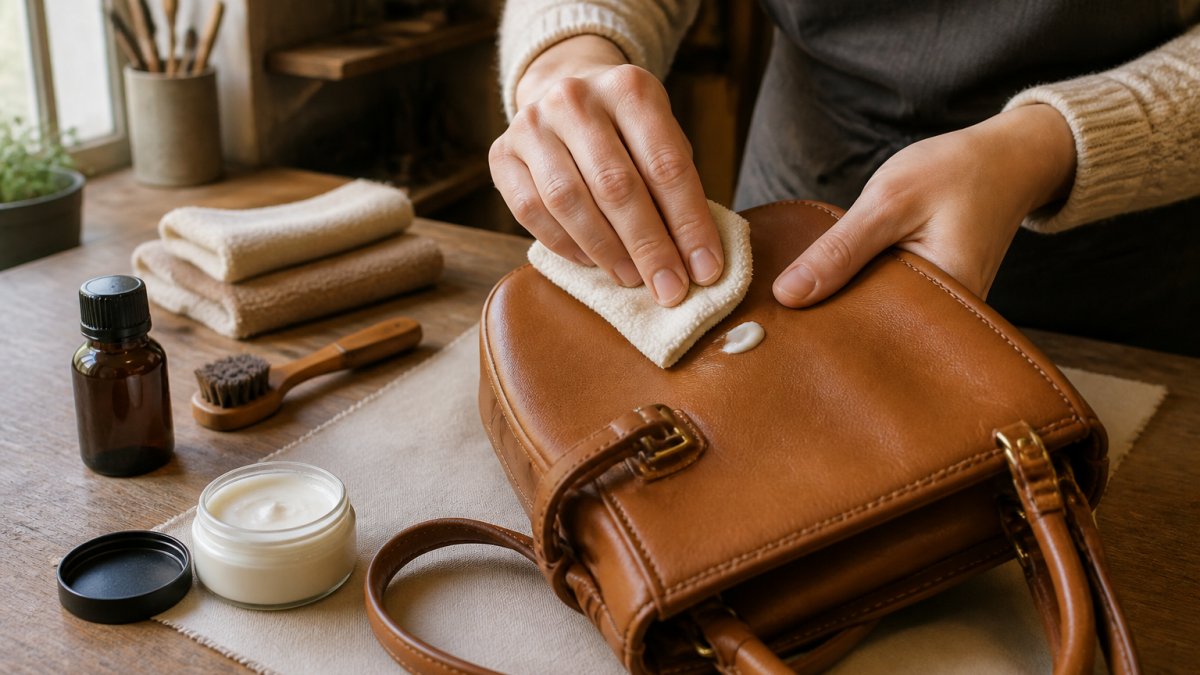
- Empty and clean the bag. Remove everything, brush out the lining, and wipe the exterior with a barely damp microfiber cloth. Let it dry fully, conditioner applied over surface dirt pushes grit into the grain, and conditioner applied over water traps moisture.
- Patch test on a hidden panel. Apply a pea-sized amount to the inside of a strap, the base, or under the flap. Wait 24 hours. Check for darkening, tackiness, and white residue in stitching. If any appear, stop and choose a lighter formula.
- Apply to the cloth, not the bag. Put a small amount of conditioner on a soft microfiber cloth and work it in with circular motions. Direct application dumps too much product in one spot, and lambskin and caviar leather stain unevenly. Two thin coats, buffed between, beat one heavy coat every time.
- Work in sections and respect the hardware. Condition the body of the bag in small sections, keeping product off hardware, edge paint, and lining. Solvent in conditioner can dull metal plating and soften edge paint; wipe any accidental contact immediately.
- Buff off the excess after 10 to 15 minutes. Use a dry cloth to remove anything the leather has not absorbed. Excess product is what turns tacky, attracts dust, and darkens at the handles.
- Rest the bag overnight. Let it sit in a cool, dry spot away from direct sun and heat before using it. A full 24 hours gives the oils time to distribute and any residue time to show up.
How Often to Condition Leather Bags (and Which Leathers to Skip)
Most finished leather bags need conditioning two to four times a year; bags carried daily or stored in dry climates may need it every other month.
Climate and storage matter as much as calendar: a bag kept near a radiator or in a dry closet dries out faster than one stored in a dust bag at room temperature. If unsure, condition less often and check the leather's feel, supple means fine, stiff means it needs attention.
The Bottom Line
The best leather conditioner for a luxury handbag is the one matched to its leather type, applied thinly, and tested first.
If you cannot find the exact product or a care item for a specific bag in our catalog, our custom sourcing service can track it down for you. Browse our handbag and care selection, or tell us what you need and we will help you find it.
Frequently Asked Questions
Can you use leather conditioner on a designer handbag?
Yes, but match the conditioner to the leather type. Smooth leathers like lambskin and caviar tolerate most quality conditioners, while suede, nubuck, and patent require specialty products or should be left to a professional. Always patch test on an inconspicuous area first. Avoid conditioners with heavy fragrance or harsh solvents, which can darken or strip delicate finishes.
How often should you condition a leather handbag?
For bags used daily, condition every 2 to 3 months. Bags used occasionally need conditioning every 6 to 12 months. Signs like dryness, stiffness, or faded color mean it's time. Over-conditioning can leave residue or attract dirt, so stick to a schedule and use a light formula for frequent touch-ups.
What leather conditioner is safe for lambskin handbags?
Look for a light, fragrance-free conditioner made for delicate leather. Chamberlain's Leather Milk and Bick 4 are gentle options. Avoid heavy waxes, oils like olive oil, and products with alcohol or solvents. Apply a thin layer with a soft cloth, let it absorb, and buff off excess. Always test on a hidden area first.
Should you test leather conditioner before using it on a handbag?
Always patch test on a hidden spot such as the inside bottom or back seam. Apply a small amount, wait 24 hours, and check for darkening, residue, or color change. This step is critical for luxury bags, where a mistake can be costly. If the leather looks unchanged and feels softer, proceed with the full application.
Finding the right conditioner for a bag you love should not mean guessing between a dozen formulas. Tools, Handbags, and More helps you source the specific care products and handbags you are looking for, including items not currently in our catalog, through our custom sourcing service. Tell us the leather type and the bag, and we will help you find the right match. Get started with Tools, Handbags, and More and give your handbag the care it deserves.