

Best Hobby Shops Online: 2026 Comparison Guide
Table of Contents
- What Separates the Best Hobby Shops Online in 2026
- Side-by-Side Comparison: Hobby Retailers by Category and Cost
- Best Online Model Kit Stores: What to Look For
- Online Model Train Stores: Scale, Inventory, and Specialty Service
- RC Hobby Stores Online: Parts Availability and Support Matter Most
- Hobbylinc Reviews and What They Reveal About Online Hobby Shopping
- Shipping, Returns, and Total Cost: The Hidden Differences Between Hobby Shops Online
- Conclusion
- Frequently Asked Questions
Last Updated: October 13, 2026
What Separates the Best Hobby Shops Online in 2026
A hobby shop sells the kits, parts, and supplies people buy to build, race, fly, or collect.
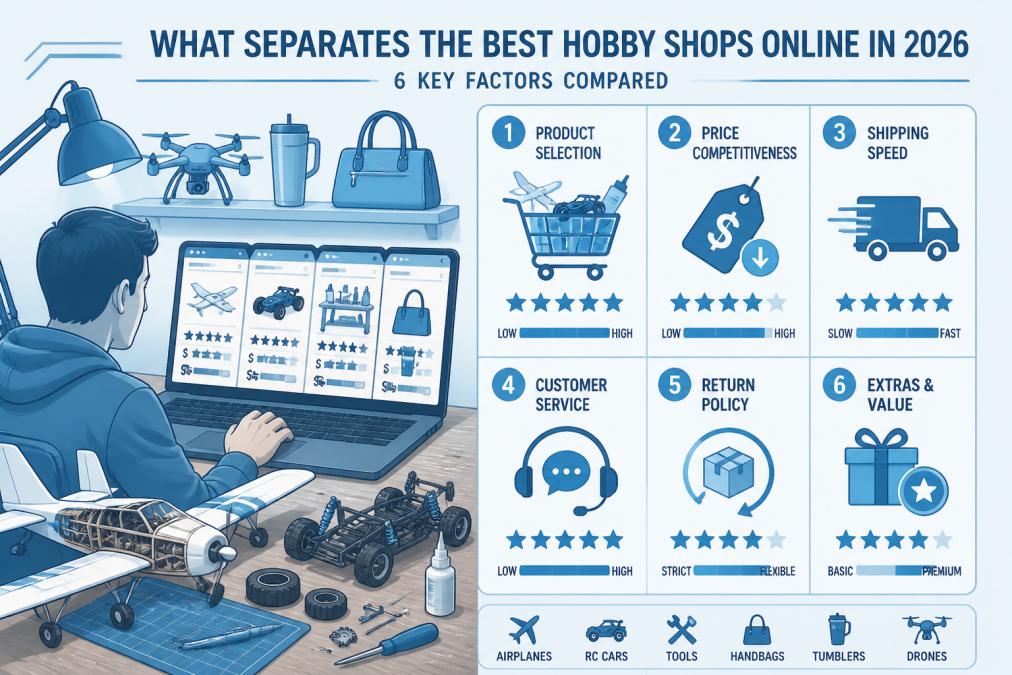
Most buyers judge a hobby store by its homepage, not its inventory depth.
At Tools, Handbags, and More, our custom sourcing service exists because we kept hearing the same complaint: the exact item was listed somewhere, but never in stock.
Side-by-Side Comparison: Hobby Retailers by Category and Cost
No single retailer wins every hobby. Model builders, train collectors, and RC enthusiasts each need different things, so the honest comparison is by category, not brand.
| Hobby Type | What to Prioritize | Watch Out For |
|---|---|---|
| Model kits | Kit selection, scale range, replacement decals | Kits listed but backordered for months |
| Model trains | Scale consistency (HO, N, O), track and parts inventory | Mixed scales with unclear labeling |
| RC vehicles | Spare parts, transmitters, batteries in stock | Cheap kits with no parts support |
| Crafts and general hobby supplies | Breadth, bundle pricing, coupon codes | Shipping thresholds that erase savings |
The pattern across all four: availability and fulfillment reliability matter more than a wide product range on paper.
Specialty stores beat general marketplaces on niche parts, while general stores win on price for common supplies, a trade-off worth naming before you commit.
Best Online Model Kit Stores: What to Look For
Model kits are where store quality diverges fastest. Two retailers can list the same 1/48 scale fighter, but only one will tell you the skill level, whether the decal sheet is in the box, and whether you can reorder a replacement canopy after you crack it.
Read the listing like a modeler, not a shopper
A useful kit listing answers four questions before you add to cart:
- Scale: Expressed as a ratio (1/72, 1/48, 1/35, 1/24). Scale determines finished size and display fit; mixing scales is the most common beginner regret.
- Skill level: Most manufacturers publish a numbered system, typically 1 through 5, where 1 is snap-together and 5 is a limited-run kit with photo-etched metal and resin parts. A store that hides this forces you to guess.
- Parts count and material: Injection-molded polystyrene is standard. Resin and photo-etch indicate a short-run kit needing cyanoacrylate glue and more patience than tube cement.
- Decal and marking options: How many liveries or squadrons are included, and whether decals are printed in-house. Old decal sheets yellow and crack.
Parts support is the real differentiator
Kits break and parts go missing. The stores worth your money publish a parts-request path, usually a form tied to the kit's item number, and stock aftermarket detail sets, metal gun barrels, resin cockpits, and replacement decals. Search the store for the kit's item number plus "sprue" or "parts", if nothing comes back, assume you are on your own when a piece snaps.
What finished-project photos actually tell you
Customer photos of completed builds reveal what no product description will: how panel lines look after a wash, whether landing gear sits level, and how proportions compare to reference photos. A kit with twenty finished-build photos and honest notes about fit issues is safer than one with a single stock render.
The beginner trap to avoid
New modelers often buy a cheap kit with no listed skill level, discover it needs aftermarket parts to look right, and quit. A better first purchase is a skill-level 1 or 2 kit from a mainstream manufacturer, a basic tool set (sprue cutters, sanding sticks, hobby knife), and thin cement. Stores that bundle these into a starter kit save three separate orders and their shipping.
Matching the store to the builder
- Beginners: Prioritize clear skill labeling, starter bundles, and responsive question channels.
- Intermediate builders: Prioritize aftermarket selection and parts reordering.
- Serious builders: Prioritize limited-run and imported kit selection, preorder reliability, and honored backorder dates.
No single store wins all three. Pick your primary store by the tier you are actually in, not the one you aspire to.
Online Model Train Stores: Scale, Inventory, and Specialty Service
Online model train stores live or die on scale consistency and parts inventory. Railroad modeling runs on exact matches: an HO locomotive needs HO track, and a store that blurs scales creates returns.
The strongest train retailers organize inventory by scale first, then era and manufacturer, so you can browse without wading through mismatched items.
When evaluating a train store, check:
- Whether scales are separated cleanly in navigation
- Whether track, rolling stock, and scenery ship from the same warehouse
- Whether the store answers questions about compatibility before you order
Customer reviews and finished-project photos are especially useful here. A layout photo tells you more about a product's real appearance than any manufacturer description.
RC Hobby Stores Online: Parts Availability and Support Matter Most
RC hobby stores online should be judged on spare parts and support, not flashy kits.
The thing nobody tells you about RC shopping is that the transmitter, batteries, and charger often cost as much as the vehicle.
Prioritize retailers that:
- List spare parts alongside each vehicle
- Stock transmitters, receivers, and batteries as separate items
- Publish clear guidance on compatibility between models and parts
Remote-control hobbies reward buyers who plan for repairs: buy the vehicle and one common spare part in the same order to avoid a grounded weekend.
Hobbylinc Reviews and What They Reveal About Online Hobby Shopping
Hobbylinc reviews tend to praise selection breadth and discount pricing, and flag the same recurring theme: shipping speed and stock accuracy.
Across hobby retailers, the same criteria surface again and again:
- Did the item arrive as described?
- Was it actually in stock when ordered?
- How did the store handle a problem?
Those three questions predict satisfaction better than star averages. A store with mixed reviews but fast, honest problem resolution often beats one with glowing reviews and no contact options.
If you are comparing hobby shops online, read the negative reviews first. They reveal how a store behaves when something goes wrong, which is the moment that matters most.
Shipping, Returns, and Total Cost: The Hidden Differences Between Hobby Shops Online
Sticker price is the least useful number in hobby shopping. The real cost is item price plus shipping plus tax plus any return, and hobby orders are unusually exposed to all four because kits, track, and batteries are bulky and heavy relative to their price.
Why hobby shipping costs more than you expect
Most carriers bill by dimensional weight, not actual weight. A model train box or large-scale kit occupies far more cubic space than its poundage suggests, so a retailer shipping in oversized boxes pays more and passes it on, which is why a single locomotive can cost more to ship than a box of paints five times its weight.
Batteries add a second layer. Lithium-polymer RC packs are hazardous materials that often cannot ship by air, limiting delivery speed and sometimes excluding them from free-shipping promotions entirely. If your cart is mostly batteries, read the shipping terms before assuming the threshold applies.
The free-shipping threshold trap
Free-shipping minimums are set to push your cart upward, and hobby carts are easy to inflate. The trap is adding filler you did not need to clear a threshold, which costs more than the shipping you avoided. Run the math both ways: if shipping is a flat rate and your filler costs more, pay the shipping.
Returns: read the window and who pays
Return policies in this category vary more than in general retail, and the variation matters most on special-order and imported items. Before ordering, confirm:
- The return window, counted from delivery or ship date. Ship-date windows are shorter in practice.
- Who pays return shipping. A prepaid label is worth real money on a heavy kit.
- Restocking fees, which some retailers apply to opened kits or electronics.
- Exclusions. Opened kits with missing sprues, cut decal sheets, and special-order items are commonly non-returnable.
A store with a 30-day window and a prepaid label is worth a slightly higher item price on anything heavy.
Tax and checkout surprises
Sales tax is collected based on destination in most states following the South Dakota v. Wayfair decision, so the same cart can cost different amounts depending on where it ships. Watch also for handling fees on oversize items, insurance add-ons, and signature-required surcharges on high-value orders. These appear at checkout, not on the product page, which is why the final total is the only number worth comparing.
A practical total-cost comparison
When you compare two stores for the same order, build the full number:
- Item subtotal
- Shipping, including any oversize or hazmat surcharge
- Estimated sales tax for your address
- Expected return cost if the item is wrong (return shipping plus any restocking fee)
- Value of your time if the store ships late and you reorder elsewhere
Stores that win on step one frequently lose on steps two through four. The store that wins the total usually has predictable fulfillment, not the lowest listed price.
Where personalized sourcing changes the math
If you are assembling an order across three stores to get everything in stock, you are paying three shipping charges and three chances at a return. Consolidating through a sourcing service that can locate the specific kit, part, or battery means one shipment, one tax event, and one point of contact if something arrives wrong.
Conclusion
The hard part of buying hobby supplies online is not finding stores. It is finding one that stocks the exact item, ships without surprise fees, and stands behind it if something goes wrong.
At Tools, Handbags, and More, we built our custom sourcing service for exactly that problem.
Get started with Tools, Handbags, and More and let us help you find the hard-to-find hobby gear you have been chasing.
Frequently Asked Questions
Is Hobbylinc a legitimate store?
Hobbylinc has operated as an online hobby retailer for decades. Customer reviews on hobby forums and independent review sites generally confirm that orders ship, though some buyers report slow processing on backordered items. Before ordering, check the item's in-stock status, read recent customer reviews, and confirm the return window. If a specific model kit is listed as backordered, contact the store first to get a realistic ship date rather than assuming it will arrive quickly.
Which online hobby shop has the best selection of model kits?
Selection varies by niche. For plastic model kits, the best online model kit stores carry both mainstream brands and limited-run imports, plus aftermarket decals and photo-etch parts. Look for a store that lists inventory in real time, shows finished builds from customers, and stocks modeling supplies like paints, adhesives, and tools alongside the kits. A shop that only carries kits but not the supplies to complete them will leave you ordering from multiple sites.
Where can I buy RC cars and parts online?
RC hobby stores online range from large general retailers to niche shops focused on specific brands. The key differentiator is parts availability: RC vehicles break, and a store that stocks replacement arms, gears, motors, and transmitters for the model you own saves you weeks of waiting. Check whether the store lists parts by model number, offers exploded-view diagrams, and has a customer service channel you can reach by phone or chat before you commit to a purchase.
What should I check before ordering from an online hobby store?
Verify four things: real-time in-stock availability (not just 'available'), the shipping threshold for free shipping and estimated delivery time, the return policy including whether opened kits can be returned, and whether customer service responds to pre-sale questions. Also compare the total cost including shipping, since a lower item price with high shipping can cost more than a higher-priced item with free shipping. Read recent customer reviews for fulfillment reliability, not just product ratings.