

Customizing Limited Edition Stainless Steel Tumblers
Table of Contents
- Why Custom Tumblers Are Worth the Effort
- What You'll Need Before You Start Customizing
- How to Make a Custom Engraved Stainless Steel Tumbler
- Sublimation and Vinyl Decals for Stainless Steel Tumblers
-
Custom Tumbler Design Ideas for Limited Editions
- Step 1: Pick the audience and the occasion
- Step 2: Choose a theme, not a color
- Step 3: Set the edition size and numbering
- Step 4: Build the design file to production specs
- Step 5: Choose the decoration method per design element
- Step 6: Package and release
- Design directions that hold up on a curved surface
- Custom Tumbler Care Instructions for Long-Lasting Finishes
- Costs, Quality Control, and Troubleshooting
- Frequently Asked Questions
Last Updated: October 6, 2026
Why Custom Tumblers Are Worth the Effort
A stainless steel tumbler is a reusable drink container made from double-walled steel with a vacuum gap that slows heat transfer, which is why customizing limited edition stainless steel tumblers keeps drinks cold for hours.
Most decoration methods are simple enough to try at home, but you must match the method to the tumbler's surface.
What You'll Need Before You Start Customizing
Gather your supplies first, because a half-finished design is hard to fix.
How to Make a Custom Engraved Stainless Steel Tumbler
A custom engraved stainless steel tumbler is made by cutting a design into the metal or its coating with a rotating bit or a focused laser beam. The mark is permanent because it removes material rather than sitting on top of it. Here is the process:
- Clean the tumbler with isopropyl alcohol and let it dry fully.
- Print or plot your design at final size on paper.
- Tape the template to the tumbler, checking level and centering.
- Set your depth: shallow for coated tumblers, deeper for bare steel.
- Engrave in slow, steady passes rather than one heavy cut.
- Wipe away debris and inspect under bright light.
- Seal bare steel with a thin oil or clear coat to slow rust.
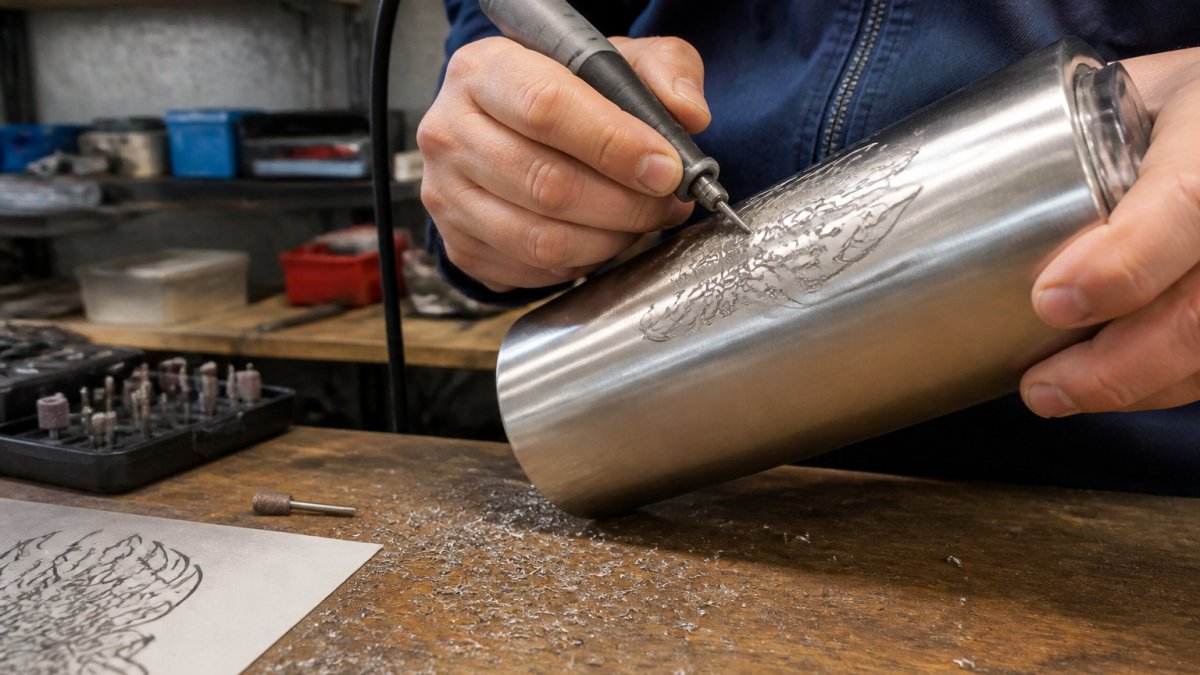
Rotary Engraving vs. Laser Engraving
Rotary engraving uses a spinning bit to cut into the surface. It costs less to start, works on bare steel, and leaves a deep, tactile mark, but it is slower and harder to keep consistent across a batch.
Laser engraving burns or vaporizes the top layer with a focused beam. It is fast, repeatable, and handles fine text well, but it costs more and strips powder coating, which can leave a dull patch if you are not careful.
| Method | Best For | Speed | Upfront Cost | Works On |
|---|---|---|---|---|
| Rotary engraving | Small batches, bare steel | Slow | Low | Bare steel, some coatings |
| Laser engraving | Fine detail, repeat runs | Fast | High | Bare steel, powder coat |
Sublimation and Vinyl Decals for Stainless Steel Tumblers
Sublimation and vinyl are the two most popular ways to add full-color artwork without cutting into the metal.
Vinyl is simpler: cut your design, weed the excess, and press it down with a squeegee. It works on almost any smooth finish and comes in matte, gloss, and metallic looks, but edges can lift with heavy washing.
Sublimation gives photographic color and no raised edge, but only works on polymer-coated tumblers, so check for a "sublimation-ready" label.
Sublimation on Polymer-Coated Tumblers
The process is straightforward once your coating is right:
- Print your design with sublimation ink and a mirror image.
- Wrap the transfer tight against the tumbler with heat tape.
- Press at the temperature your coating maker specifies.
- Let it cool completely before peeling.
- Inspect for ghosting or faded patches.
Custom Tumbler Design Ideas for Limited Editions
A limited edition works when the design tells a clear story and the run is deliberately small. The mistake first-timers make is treating "limited" as a marketing label instead of a production plan. A real limited edition has a defined theme, a fixed edition size, a numbering system, and a release date. Here is a concept-to-launch workflow for a 25- to 100-unit drop.
Step 1: Pick the audience and the occasion
Start with who will buy it and why now. A reunion, a local 5K, a brewery anniversary, a wedding party, or a business milestone all give buyers a reason to act. Write one sentence: "This tumbler is for ___ to mark ___." If you cannot finish it, the design will feel generic.
Step 2: Choose a theme, not a color
A theme is a story; a color is a preference. Strong limited-edition themes include:
- A single landmark or skyline rendered as a line drawing
- A milestone year, such as "Est. 2016" or "10 Years"
- A seasonal motif tied to a specific month
Keep the palette to two or three colors. On a curved 20 oz or 40 oz body, fine lines disappear at arm's length and busy patterns look muddy.

Step 3: Set the edition size and numbering
Edition size should match your realistic production capacity, not your optimism, commonly 25, 50, or 100 units. Number each piece on the base with a method that matches your decoration:
- Laser or rotary engraving: "001/050" cut directly into the base
- Sublimation: a small numbered panel printed with the wrap
- Vinyl: a die-cut number decal applied after the main design
Numbering separates a limited edition from a regular custom order and makes each unit photographable and resellable.
Step 4: Build the design file to production specs
Before you print or cut anything, prepare the artwork:
- Measure the printable area of your specific blank. A 20 oz tapered tumbler typically offers a wrap roughly 8 to 9 inches wide and 5 to 6 inches tall, but confirm on your own blank.
- Build at 300 DPI at final print size. Vector files are preferred for engraving and vinyl cutting.
- Add 0.125 inch bleed on all sides for sublimation wraps so seams do not show white.
- Convert text to outlines or embed fonts to avoid substitution errors.
Step 5: Choose the decoration method per design element
Most limited editions use more than one method. A practical split:
- Main artwork: sublimation for full color, or vinyl for bold single-color shapes
- Names and numbers: laser or rotary engraving for permanence
- Accent details: vinyl for metallic or matte finishes
Match the method to the surface. Bare stainless steel accepts engraving and vinyl. Polymer-coated blanks accept sublimation. Powder-coated blanks accept laser engraving but the beam strips the coating, so plan the contrast intentionally.
Stanley 40 oz Quencher H2.0 Dior Style Pattern New in box. B-356 →
Step 6: Package and release
Packaging is part of the limited-edition experience. A kraft box, a printed card with the edition number and care instructions, and a tissue wrap cost little and raise perceived value. Release timing matters too: one announcement date, a fixed quantity, and a clear "sold out" point create urgency without a hard sell.
Design directions that hold up on a curved surface
For custom tumbler design ideas, try these directions:
- Numbered runs, such as "001 of 100," engraved on the base
- A single bold logo in one accent color
- A repeating pattern that wraps the full body
- A short quote engraved in a clean serif
Keep the palette to two or three colors; busy designs look muddy on a curved surface.
Custom Tumbler Care Instructions for Long-Lasting Finishes
Care depends on the method: engraved bare steel needs occasional oiling to prevent rust, while vinyl and sublimation need gentle washing. Follow these custom tumbler care instructions:
- Hand wash with mild soap and a soft sponge
- Skip the dishwasher for any decorated tumbler
- Avoid abrasive pads and citrus cleaners
- Do not soak for long periods
Costs, Quality Control, and Troubleshooting
Small-batch economics come down to four numbers: the blank tumbler, the decoration cost per unit, any setup fee, and your time. A limited run needs a per-unit landed cost so you can set a price that covers waste and still feels fair.
Per-unit cost by method
Costs vary by supplier and volume, but the structure is consistent:
- Vinyl: lowest upfront tool cost (cutting machine, transfer tape, vinyl). Per-unit material cost is small, but labor is high because weeding and applying are manual.
- Sublimation: moderate upfront cost for a heat press and printer, plus ink, transfer paper, and heat tape per unit. Best per-unit economics past roughly 20 to 30 units.
- Rotary engraving: low tool cost, high labor per unit. Best for bare steel and very small runs.
- Laser engraving: highest upfront cost, fastest per-unit time, and most repeatable, so it wins on runs above roughly 50 units.
Setup fees and minimum order quantities are the hidden line items. Custom blanks, custom packaging, and custom numbering plates often carry a one-time setup charge. Ask for it in writing before you commit to an edition size.
Pricing a limited run
A simple formula: (blank cost + decoration cost + packaging + waste allowance) x markup. Waste allowance matters: on a first run, plan for 5 to 10 percent of units to fail QC and be remade or sold as seconds, or your margin disappears on the first bad batch.
Quality control checklist
Quality control matters more on a limited run because one bad tumbler stands out in a set of fifty. Check every piece for:
- Level placement: the design sits square to the lid and base
- Even depth or even ink coverage across the full wrap
- Clean edges with no lifting, ghosting, or stray marks
- Correct edition number, applied once and legibly
Photograph each finished tumbler before it ships; a consistent photo set doubles as proof of edition size and marketing for the next drop.
Method-selection quick guide
Use this to pick a method before you buy supplies:
| Goal | Best method | Why |
|---|---|---|
| Full-color photo or gradient artwork | Sublimation | Only method that bonds full color into a coating |
| Permanent name or number on bare steel | Rotary or laser engraving | Removes material, cannot peel |
| Bold single-color logo, low budget | Vinyl | Cheapest tooling, works on most finishes |
| Large repeatable batch with fine text | Laser engraving | Fastest and most consistent per unit |
| Metallic or matte accent | Vinyl | Widest finish range without coating changes |
Common problems and their fixes
- Faded sublimation: too little pressure or heat, so press longer or hotter
- Lifting vinyl: surface was not clean, so re-wipe and re-press
- Uneven engraving: too fast a pass, so slow down and add passes
- Rust spots: bare steel was unsealed, so oil the surface
For the blank itself, our Stanley 40 oz Quencher H2.0 in a Dior-style pattern gives you a 40 oz stainless steel body with an iridescent rim, a clear straw, and a white handle . If you want a simpler canvas, our cream Stanley 40 oz tumbler and brite yellow Stanley 40 oz tumbler both ship new in box with the FlowState lid.


If a specific colorway is not in our catalog, our custom sourcing service will hunt it down for you.
Frequently Asked Questions
How can you customize a limited-edition stainless steel tumbler?
Customizing limited-edition stainless steel tumblers can involve various methods. Each method suits different design goals, so consider what you want to achieve.
Can you engrave a limited-edition stainless steel tumbler?
Engraving is a method that can be used on stainless steel tumblers. This method removes the surface finish where it cuts, so the engraved area may appear silver against a colored tumbler.
Can vinyl decals be used on stainless steel tumblers?
Vinyl decals adhere well to smooth stainless steel surfaces and are a popular choice for names, monograms, and simple graphics. They are removable, which makes them a good option if you want to change the design later. However, vinyl can peel over time with frequent washing. Hand-washing and avoiding abrasive sponges extend the life of vinyl decals on stainless steel tumblers significantly.
How do you clean a customized stainless steel tumbler?
To care for customized tumblers, hand-wash them with warm water, mild dish soap, and a soft sponge. Avoid dishwashers. Dry immediately with a soft cloth to prevent water spots on the finish.
Limited runs live or die on planning. Pick your method, match it to the finish, and test before you commit a whole batch. Tools, Handbags, and More carries Stanley tumblers in several colorways, and our custom sourcing service can track down the specific edition you want. Browse the collection, or tell us what you are looking for and we will find it.