

How to Compare Online Shopping Sites: 2026 Guide
Table of Contents
- Why a Few Extra Minutes of Comparison Save Real Money
- The 5-Point Framework to Compare Online Shopping Sites
- Using the Best Price Comparison Websites Effectively
- How to Check if an Online Store Is Legit Before You Buy
- A Practical Retailer Return Policy Comparison
- Hidden Costs: Dynamic Pricing, Cross-Border Fees, and Data Tracking
- Conclusion: Build a Repeatable Smart Shopping Routine
- Frequently Asked Questions
Last Updated: September 9, 2026
Why a Few Extra Minutes of Comparison Save Real Money
The sticker price is rarely the price you pay. Between shipping fees, taxes, and the occasional impulse add-on, that "great deal" can quietly become an average one. Learning how to compare online shopping sites effectively is the single fastest way to stop leaving money on the table, and it takes only a few extra minutes per purchase.
Comparison shopping evaluates identical or similar products across multiple retailers to find the best total value, not just the lowest listed price. It accounts for shipping, return policies, and seller reliability alongside the base cost. Below, we'll show you how to build a repeatable routine that works for everything from a new drill to a limited-edition tumbler.
The 5-Point Framework to Compare Online Shopping Sites
Most guides treat price comparison as a single action, but effective deal hunting requires a structured approach. We use a five-point framework that balances cost against risk and convenience, ensuring you never sacrifice reliability for a few dollars.
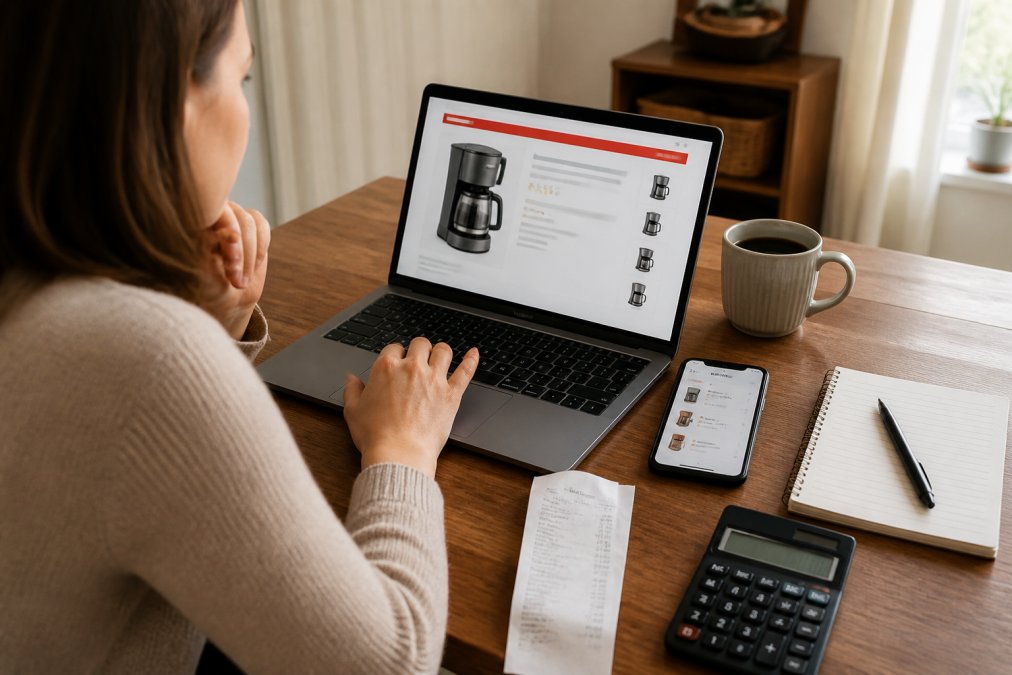
The framework evaluates every purchase against these criteria:
- Total landed cost (item price plus shipping and taxes)
- Shipping speed and delivery reliability
- Return policy flexibility and restocking fees
- Store legitimacy and customer support quality
- Price history to confirm the deal is real
The last point is the one most shoppers skip. A "40% off" sale is meaningless if the retailer raised the base price two weeks ago. Price history tracking tools show the actual pricing trend, distinguishing genuine discounts from marketing tactics.
Total Landed Cost vs. Sticker Price
The most common mistake in online shopping is comparing sticker prices while ignoring the total landed cost, which includes the product price, shipping fees, sales tax, and any handling charges. A handbag listed at $80 with free shipping beats a $70 bag with $15 shipping and a $5 handling fee, yet many shoppers abandon the cart without doing the math.
Add every fee you can identify before entering your payment details. Many platforms display this estimate on the product page, but not all do. When a site hides shipping costs until the final step, proceed with caution and compare against transparent retailers.
Shipping Speed and Product Availability
A lower price means nothing if the item arrives after you need it. Shipping speed matters most for time-sensitive purchases like birthday gifts or replacement parts. Before committing, check the estimated delivery window against the retailer's stated dispatch times.
Product availability also affects your comparison. A refurbished item at a steep discount might be tempting, but verify the condition grading and warranty coverage. If a product shows low stock across multiple retailers, the urgency is real, and waiting may leave you empty-handed.
Using the Best Price Comparison Websites Effectively
Price comparison websites are powerful, but they are not neutral arbiters of price. Most aggregators earn money through affiliate commissions or advertising fees from retailers who pay to be listed more prominently. This creates a subtle bias: results are not always sorted purely by lowest price.
How Comparison Engines Actually Rank Results
The engine's default sort is rarely "lowest price"; it is often "sponsored" or "merchant rank," which prioritizes retailers who pay higher fees. Manually re-sort by selecting "Price: Low to High." Even then, verify the final price by clicking through, because the listed price often excludes shipping or requires a specific coupon code.
The Two Types of Comparison Tools: Real-Time vs. Historical
A critical distinction is the difference between real-time price comparison and price history tracking. Real-time tools, like Google Shopping or ShopSavvy, show the current price across multiple retailers at this exact moment. They are excellent for commodity items like electronics where you need the best price today.
Price history trackers, like CamelCamelCamel or Keepa, show the price trend of a specific item over weeks, months, or years. A real-time comparison might show a drill at $99, but a history tracker will reveal it has been $79 for three months, making $99 a temporary increase. For non-urgent purchases, checking price history is the single most effective way to avoid fake discounts.
A Practical Selection Framework
To use these tools effectively, match the tool to the purchase type:
- For commodity items (identical models): Use a real-time aggregator like Google Shopping. Filter by total price including shipping, and sort by lowest total cost.
- For big-ticket items (over $200): Use a price history tracker to understand the typical price range. If the current price is at or near the historical low, it is a genuine deal. If it is in the middle of the range, wait unless you need it immediately.
- For items with model variations (e.g., laptops with different RAM): Use the aggregator to find the specific configuration you want, then cross-reference the retailer's site directly for exclusive configurations or bundle deals that the aggregator may not list.
The Blind Spots of Aggregators
Even the best aggregators have blind spots. They rarely index flash sales, loyalty member pricing, or niche retailers, and they struggle with variable specifications like handbags or collectibles where condition matters. The "lowest price" might be for a version you do not want. In these cases, a targeted search or a retailer with a human sourcing service is often more effective.
The Privacy Trade-Off of Using These Tools
Every time you use a free comparison tool, you are often paying with your data. Many sites and their browser extensions track your search history to build a profile for advertisers. If you are concerned about privacy, use the aggregator's website directly in a private browsing window rather than installing its extension, which typically has broader access to your browsing data.
How to Check if an Online Store Is Legit Before You Buy
Shopping on an unfamiliar site carries risk, and knowing how to check if an online store is legit is vital. The cheapest price is worthless if the store never ships your order or sells counterfeit goods. A two-minute verification routine prevents most common fraud scenarios.
Start with the store's contact information. A legitimate business provides a physical address, a working phone number, and a responsive email address, not just a contact form. Next, read user reviews on independent platforms rather than testimonials hosted on the retailer's own domain, which can be selectively curated. The Federal Trade Commission guidance on online shopping recommends checking for clear return and refund policies before you buy.
Look for these trust signals:
- A padlock icon and "https" in the browser address bar
- Clear terms of service and privacy policy pages
- Third-party payment options that offer buyer protection
- Responsive customer service that answers questions before purchase
If a deal seems too good to be true, it usually is. Compare the price against the range shown by the best price comparison websites; a massive outlier discount on a brand-name item is a red flag. When in doubt, a quick search for the store name plus "scam" or "review" often surfaces warnings from other shoppers.
A Practical Retailer Return Policy Comparison
Return policies vary dramatically between retailers, and the difference can cost you real money. A retailer return policy comparison should happen before you order, not after the item doesn't fit. Key details to examine are the return window, restocking fees, and who pays for return shipping.
| Policy Feature | Generous Retailer | Restrictive Retailer | What to Check |
|---|---|---|---|
| Return window | 60-90 days | 14-30 days | Count from delivery, not order date |
| Restocking fee | None | 10-20% of item price | Applies to electronics and large items |
| Return shipping | Free prepaid label | Deducted from refund | Verify before ordering |
| Condition required | Original packaging optional | Unopened, tags attached | Read the fine print |
| Refund speed | Immediate to 5 days | 2-4 weeks after receipt | Impacts your cash flow |
Items bought through third-party marketplaces often carry the marketplace's policy, not the individual seller's, which can complicate returns. For custom or sourced items, clarify return terms before committing.
Hidden Costs: Dynamic Pricing, Cross-Border Fees, and Data Tracking
The price you see is rarely the price you pay, and the difference comes from three hidden forces: dynamic pricing algorithms, cross-border logistics, and the data economy that funds "free" shopping tools.
Dynamic Pricing: How Retailers Adjust Prices in Real Time
Dynamic pricing adjusts prices based on real-time supply and demand, competitor pricing, and sometimes your browsing behavior (the FTC). Amazon changes prices on millions of items multiple times per day. Prices for frequently viewed items may increase if you visit the product page repeatedly without buying, as the algorithm interprets your interest as a higher willingness to pay.
To counter this, use a private browsing window or clear your cookies before checking a price. More importantly, use a price history tracker to see the range over time. If the current price is at the high end of the historical range, wait 24 to 48 hours; prices often cycle back down.
Cross-Border Purchases: Calculating the True Landed Cost
When you buy from an international retailer, the total landed cost includes the item price, international shipping, currency conversion fees (typically 1-3% above the mid-market exchange rate), and potentially U.S. customs duties.
The U.S. Customs and Border Protection (CBP) assesses duties based on the item's Harmonized System (HS) classification and declared value. For most consumer goods, the duty rate ranges from 0% to 17.5%, but it can be higher for textiles or footwear. Shipments valued under $800 are generally admitted duty-free under the Section 321 provision, but this threshold applies per person per day, so multiple same-day purchases may be combined and exceed it (cbp.gov).
Before ordering from an international site, use the CBP's online tariff lookup tool to estimate the duty rate. Add that estimated duty, plus shipping and currency conversion fees, to the item price. Only then compare that total against domestic options. A $50 item from a U.K. retailer with $15 shipping and a 10% duty rate costs $71.50 total, which may be more expensive than a $65 domestic option with free shipping.
The Data Tracking Economy: What "Free" Tools Really Cost
Many price comparison sites, browser extensions, and shopping apps are free because they monetize your data. They track your browsing history, search queries, and purchase behavior, then sell that data to advertisers or use it to serve targeted ads.
The privacy cost is not just theoretical. Data brokers can build detailed profiles that include your income level, shopping habits, and even health-related searches, which can influence the prices you are shown and the ads you see.
To compare shopping sites without sacrificing your privacy, follow these practices:
- Use the website directly, not the browser extension. Extensions often have access to all pages you visit, not just shopping sites. The website itself has more limited access.
- Disable cross-site tracking in your browser settings. In Chrome, this is under Privacy and Security > Third-party cookies. In Safari, it is under Privacy > Prevent cross-site tracking.
- Use a privacy-focused browser like Firefox with Enhanced Tracking Protection enabled, or Brave, which blocks trackers by default.
- Pay with a virtual credit card number from your bank or a service like Privacy.com to prevent retailers from sharing your actual card number with data aggregators.
The Hidden Cost of "Free" Shipping
Finally, "free shipping" is rarely free. Retailers bake shipping costs into the item price or require a minimum purchase threshold (often $35 to $50). When comparing two sites, one with a $40 item and free shipping and another with a $35 item and $7 shipping, the second option is actually cheaper at $42. Always calculate the total cost to your door.
Conclusion: Build a Repeatable Smart Shopping Routine
Effective comparison shopping is not about spending hours hunting for pennies; it is about building a five-minute habit that protects your budget on every purchase. Apply the five-point framework, check the total landed cost, verify the retailer's legitimacy, and understand the return policy before you click buy. Over time, this routine becomes automatic, and the savings compound.
The routine also handles purchases that fall outside it, the limited-edition items and niche products that standard comparison tools cannot find. When your search leads to a dead end, a retailer that offers real human assistance can make a difference. Tools, Handbags, and More pairs a diverse catalog with a custom sourcing service that tracks down specific items not currently in stock. Get started with Tools, Handbags, and More and turn every purchase into a confident, well-researched decision.
Frequently Asked Questions
What is the fastest way to compare prices across multiple online stores?
Start with a price comparison website like Google Shopping or Shopzilla to get a baseline. Then, use a browser extension that automatically checks for coupon codes at checkout. For big-ticket items, spend a few extra minutes checking the retailer's own site and one or two direct competitors. The fastest reliable method is to compare the total landed cost, which includes shipping and taxes, not just the base price.
How can I tell if an online store is legitimate and not a scam?
Look for a physical address and a working customer service phone number. Read the retailer return policy comparison details before ordering, and check third-party review sites like the Better Business Bureau. Pay with a credit card, which offers stronger fraud protection than debit cards. Be skeptical of deals that are far below market price, and verify the site's SSL certificate by checking for 'https' in the browser bar.
What factors besides price should I compare when choosing an online retailer?
The most important factors are the total landed cost, which includes shipping and taxes, and the return policy. Check the return window, who pays return shipping, and if there are restocking fees. Consider shipping speed and reliability, the availability of customer support, and the store's legitimacy. A slightly higher price is often worth it for a no-hassle return process and a better customer service experience.
Why do prices for the same item change so often between websites?
Many large retailers use dynamic pricing, which adjusts prices in real time based on demand, your location, and your browsing history. Prices also change with inventory levels and competitor pricing. To get the best deal, track the price over a few days using a price history tool. This helps you avoid being caught by a temporary spike and recognize a genuinely good sale when you see one.