

How to Find Specific Drone Parts: A Complete Guide
Table of Contents
- How to Identify Your Drone Model and Serial Number
- Understanding OEM Part Numbers and SKUs
- Using a Drone Part Compatibility Checker
- Finding Specific Components: Motors, ESCs, and Frames
- Sourcing Parts Through Custom Drone Part Sourcing Services
- Identifying Counterfeit Parts and Verifying Authenticity
- DIY Build vs. Replacement Parts: When to Source What
- Conclusion
Last Updated: August 25, 2026
How to Identify Your Drone Model and Serial Number
Finding specific drone parts starts with knowing exactly what you're looking for. The first step is identifying your drone model and locating its serial number, which unlocks access to OEM part numbers and compatibility information you'll need to source the right components.
Every drone has a unique identifier. Most manufacturers print the model name and serial number on the underside of the aircraft, typically on a label near the battery compartment or on the frame itself. Some models also display this information in their companion app or in the firmware settings. Write down both pieces of information, you'll reference them repeatedly when searching for parts.
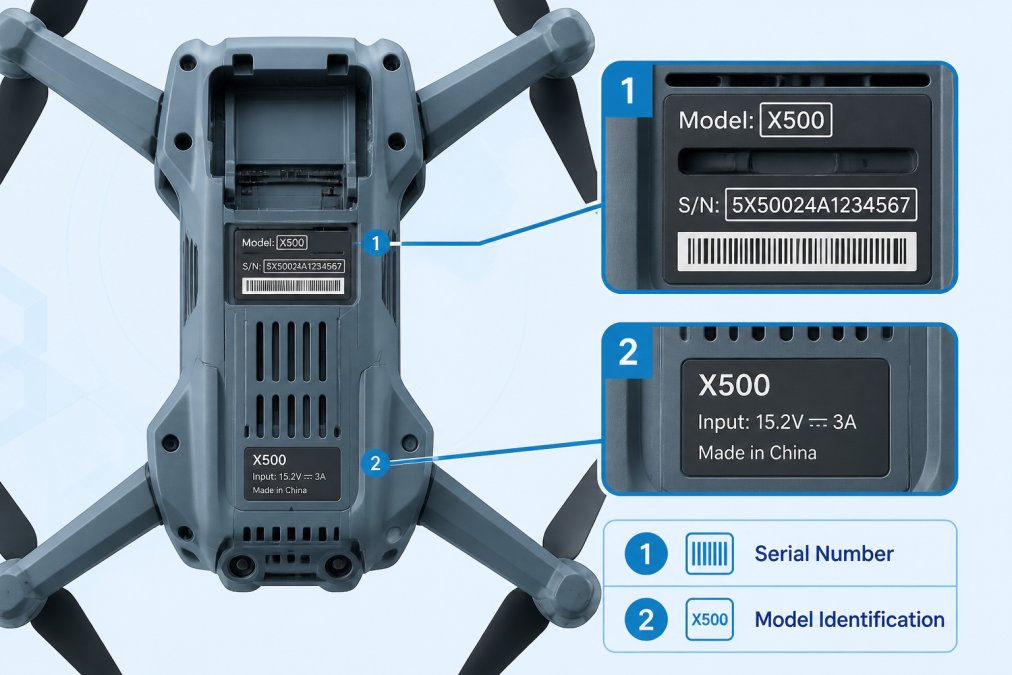
The serial number matters because it tells you the exact manufacturing batch and firmware version your drone shipped with. This becomes critical when sourcing replacement components, especially for flight controllers and electronic speed controllers that must match your specific hardware revision. Some manufacturers released multiple versions of the same model with different internal architectures, and installing incompatible parts can prevent your drone from functioning.
If you've lost the original packaging or can't locate the label, check your purchase receipt or warranty documentation. Many retailers print the model and serial number on their records. You can also contact the manufacturer's support team with your purchase information, and they'll provide the details you need.
Once you have the model and serial number, you're ready to move to the next phase: understanding how part numbers work and where to find the components you need.
Understanding OEM Part Numbers and SKUs
OEM part numbers and SKUs are the language manufacturers use to identify specific components. Each part has a unique designation that distinguishes it from similar-looking alternatives. Learning to read these numbers saves you from ordering the wrong item and wasting money on incompatible hardware.
An OEM part number typically includes information about the component type, generation, and specifications. For example, a brushless motor's part number might include its KV rating (revolutions per minute per volt) and the number of poles. An electronic speed controller's SKU might encode its voltage rating and maximum current draw. These details matter because they determine whether a part will work with your specific drone.
The challenge is that different manufacturers use different naming conventions. Some use simple numeric codes, while others use alphanumeric sequences with embedded specifications. The best approach is to cross-reference the part number against the manufacturer's official documentation or parts catalog. Most reputable manufacturers publish detailed parts lists on their websites, organized by drone model and including high-resolution images so you can visually confirm you're ordering the correct item.
When you find a part number, verify it against at least two sources before purchasing. Check the official manufacturer website, authorized retailers, and community forums where other users discuss that specific drone model. If the part number appears consistently across multiple sources with identical specifications, you've found the right component.
Using a Drone Part Compatibility Checker
A drone part compatibility checker simplifies the process of verifying that components will work together. These tools, whether online databases, manufacturer apps, or community-maintained wikis, cross-reference your drone model against available parts and flag incompatibilities before you spend money.
The most reliable compatibility checkers are maintained by the drone manufacturers themselves. DJI, for instance, provides an official parts catalog on their website where you can select your model and see all compatible replacement components. These official tools are authoritative because they're built directly from the engineering specifications the manufacturer used during design.
Community-maintained databases like those found on Reddit forums and dedicated drone enthusiast sites offer a different advantage: real-world testing feedback. Hobbyists document which third-party motors, frames, and controllers actually work with specific drone models, and they flag combinations that cause problems. This crowdsourced knowledge is invaluable for DIY builds where you're mixing components from multiple manufacturers.
When using a compatibility checker, enter your exact drone model and serial number if the tool requests it. Some checkers filter results based on your specific hardware revision, which matters because a part compatible with revision 2.1 might not work with revision 3.0. Take the time to verify that the checker's recommendation matches your research from other sources, no single tool is infallible.
Finding Specific Components: Motors, ESCs, and Frames
Brushless Motors and Electronic Speed Controllers
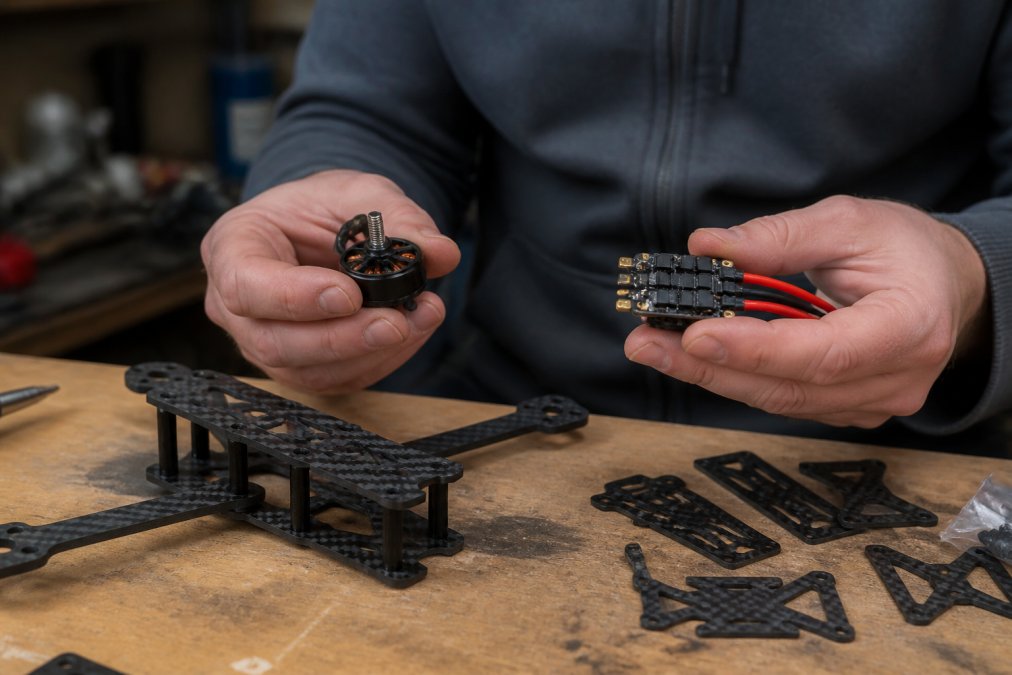
Brushless motors and electronic speed controllers (ESCs) are the most frequently replaced drone components because they wear out with regular use. Sourcing replacements requires understanding the specifications that determine compatibility.
Brushless motors are rated by KV, which measures how many RPM the motor spins per volt of input. A 2300 KV motor spins faster than a 1000 KV motor under the same voltage (peer-reviewed research). Your drone's flight controller expects motors within a specific KV range, and installing motors outside that range will cause stability and performance issues. When ordering replacement motors, match the KV rating, number of poles, and mounting pattern to your original components.
Electronic speed controllers regulate power delivery from the battery to the motors. They're rated by voltage (typically 3S, 4S, or 6S LiPo) and maximum current draw (often 30A, 40A, or higher). Installing an ESC rated for lower current than your motors require will cause it to overheat and fail (ieee.org). Installing one rated for much higher current than necessary wastes weight and money but won't damage anything.
The challenge with sourcing these components is that manufacturers often discontinue older models. When you can't find the exact OEM replacement, you have two options: source equivalent third-party components with matching specifications, or explore 3D printing alternatives for mechanical parts like motor mounts and frames.
Drone Frames and Flight Controllers
Drone frames provide the structural foundation and determine your maximum all up weight (AUW) capacity. When sourcing a replacement frame, verify that it accepts the same mounting patterns as your original, different frame designs use different hole spacing and connector types.
Flight controllers are the computer that stabilizes your drone and processes sensor input. They're the most sensitive component to compatibility issues. A flight controller designed for one frame layout often won't fit in a different frame without custom mounting brackets. Before ordering a replacement flight controller, confirm that it matches your original's form factor, connector types, and firmware version.
Many drone hobbyists source frames and flight controllers from specialist retailers that focus on FPV racing drones or custom builds. These retailers stock components from manufacturers like Matek, Betaflight, and iFlight. They often provide detailed compatibility information and can advise on whether a component will work with your specific setup.
Sourcing Parts Through Custom Drone Part Sourcing Services
When you can't find a specific component through standard retail channels, custom drone part sourcing services can help. These specialized services work with manufacturers, distributors, and global suppliers to locate hard-to-find parts, including legacy components for older drone models.
Tools, Handbags, and More offers a custom sourcing service designed specifically for situations where you need a component that isn't in current stock. Their team understands drone part compatibility and can help you find exact OEM replacements or equivalent third-party components that match your specifications. This service is particularly valuable when you're repairing an older drone model where the original manufacturer no longer produces replacement parts.
The sourcing process typically begins with you providing your drone model, serial number, and the specific component you need. The service then searches their network of suppliers and manufacturers to locate the part. Availability depends on the specific part's rarity.
Using a custom sourcing service can be a valuable option when standard retail channels don't have what you need, as it can save time you'd spend searching across multiple websites and contacting manufacturers directly. For serious hobbyists and professionals who need drones operational quickly, this service can be a worthwhile investment.
Identifying Counterfeit Parts and Verifying Authenticity
Counterfeit drone parts are a real problem in online marketplaces (the FTC). Fake brushless motors, ESCs, and flight controllers appear identical to genuine components but perform poorly or fail entirely. Learning to identify counterfeits protects you from wasting money and damaging your drone.
Genuine OEM parts come with specific packaging, documentation, and serial numbers. Counterfeit parts often have misspelled labels, poor print quality, or inconsistent packaging design compared to authentic components. If you're ordering from a marketplace seller rather than an official retailer, request high-resolution photos of the packaging before purchasing.
The most reliable way to verify authenticity is to purchase from authorized dealers. Manufacturers maintain lists of authorized retailers on their official websites. These retailers have direct relationships with manufacturers and can guarantee the parts they sell are genuine. The prices may be slightly higher than marketplace sellers, but the assurance of authenticity is worth the premium.
When you receive a component, inspect it carefully. Genuine parts have consistent build quality, proper labeling, and come with documentation. If something feels off, loose components, misaligned labels, or missing documentation, contact the seller immediately and request a replacement or refund.
DIY Build vs. Replacement Parts: When to Source What
Deciding whether to source individual replacement parts or pursue a complete DIY build depends on your repair needs and technical skill level.
If your drone has a single failed component, a damaged motor or broken frame, sourcing a replacement part makes sense. Identify the failed component, find the OEM part number, and order the replacement. This approach typically costs less than rebuilding the entire drone and gets you flying again quickly.
A DIY build is worth considering when you're upgrading an older drone or customizing one for specific performance characteristics. Building from scratch allows you to select components that match your exact needs: lighter frames for racing, heavier-duty ESCs for professional work, or specialized flight controllers for autonomous missions. However, DIY builds require more technical knowledge and troubleshooting skills.
Before starting a DIY build, research whether 3D printing is a viable option for frame components. Many drone enthusiasts design and share 3D-printable frames optimized for specific applications. These custom frames often perform better than OEM alternatives for specialized use cases, though they require access to a 3D printer and basic mechanical skills to assemble.
The warranty implications differ significantly between sourcing replacement parts and DIY builds. Replacement parts from authorized retailers typically carry manufacturer warranties. Components you source independently or 3D-printed parts you manufacture don't carry warranties, so you're assuming all responsibility if something fails.
Finding specific drone parts becomes straightforward once you understand where to look and what information you need. Start by identifying your exact drone model and serial number, then use OEM part numbers to source genuine components through authorized retailers. When you hit a dead end with standard sourcing channels, Tools, Handbags, and More's custom sourcing service can help locate even the most elusive parts. Whether you're replacing a single motor or building a custom drone from scratch, you now have the framework to source the right components efficiently.
Frequently Asked Questions
Where can I find drone parts if my model is no longer in production?
For discontinued models, start by searching the OEM part number on specialized drone part aggregators and hobbyist forums. If parts are truly unavailable, custom sourcing services can help locate stock from international retailers or used marketplaces. For legacy support, 3D printing compatible frames or adapters is increasingly viable. Tools, Handbags, and More offers custom sourcing assistance to track down even hard-to-find components for older drone models.
How do I verify that a third-party drone part is compatible with my specific model?
Use a drone part compatibility checker by entering your model number and the component's OEM part number or SKU. Cross-reference the voltage rating, current draw, connector types, and mounting patterns with your drone's technical documentation. Check the manufacturer's wiring diagrams and build lists to confirm interoperability. When in doubt, contact the part supplier directly with your drone's serial number and specifications.
What's the difference between buying replacement parts and sourcing components for a DIY build?
Replacement parts are OEM or certified alternatives designed for your specific drone model, maintaining warranty coverage and guaranteed compatibility. DIY builds require deeper technical knowledge, you source individual flight controllers, brushless motors, ESCs, frames, and batteries, then assemble and configure firmware yourself. DIY builds offer customization but void manufacturer warranty. Replacement parts are faster and safer for most users.
How can I avoid counterfeit drone parts when sourcing online?
Buy directly from authorized retailers or verified distributors whenever possible. Check packaging for spelling errors, poor quality printing, or mismatched branding. Verify the OEM part number matches official documentation exactly. Request certificates of authenticity for high-value components like flight controllers. If a price seems unusually low, it's likely counterfeit. Reputable sourcing services vet suppliers to reduce counterfeit risk.
This article was written using GrandRanker