

How to Spot Authentic Designer Handbags
Table of Contents
- Why Spotting Fakes Matters More Than Ever
- Common Signs of Counterfeit Handbags to Check First
- How to Verify Luxury Bag Serial Numbers and Date Codes
- Materials, Logo Placement, and Brand Standards
- The Smell Test and Other Chemical Indicators
- Digital Authentication: NFC Chips and Microchips
- When to Use Designer Bag Authentication Services
- Your Step-by-Step DIY Photo Guide for Remote Authentication
- Frequently Asked Questions
Last Updated: September 5, 2026
Why Spotting Fakes Matters More Than Ever
The global market for counterfeit luxury goods has exploded, and the rise of "superfakes" means even seasoned shoppers can be fooled (oecd.org). This guide from Tools, Handbags, and More breaks down the physical, chemical, and digital checks that separate genuine luxury items from clever impostors.

Authenticating a designer bag protects your investment and ensures you get the craftsmanship and durability you pay for. Below, we'll show you how to inspect a bag systematically, from stitching to serial number to smell, and when to rely on professional authentication services, because some fakes are too good for a visual check alone.
Common Signs of Counterfeit Handbags to Check First
Most counterfeit handbags fail basic visual inspection. Start with a broad scan of the bag's overall silhouette, symmetry, and presence, as genuine designer pieces are constructed to exacting brand standards.

Stitching and Craftsmanship
Authentic luxury bags are known for their impeccable stitching, often the fastest way to identify a fake. On a genuine bag, you should see consistent, tight, and perfectly aligned stitches that match the bag's color and are evenly spaced. Counterfeiters often use cheaper machines that produce uneven, loose, or slanted stitches, and they frequently use the wrong thread color.
Don't ignore the interior stitching, which is just as important as the exterior. Check the seams where the lining meets the leather and the edges of the handles. Loose threads, skipped stitches, or a stitch line that veers off course are major red flags. Authentic brands also seal or finish the raw edges of their leather, whereas fakes often leave them rough.
Hardware Weight and Finish
Pick up the bag and focus on the feel of the zippers, clasps, and feet. High-end brands use solid, heavy metal hardware that feels substantial in your hand. Counterfeit bags frequently use hollow or lightweight plated metal that feels cheap and flimsy.
The finish on authentic hardware is smooth, scratch-resistant, and free of imperfections. Run your finger over the engravings on a zipper pull or snap button; they should be crisp, deep, and legible. On fakes, the engraving is often shallow, rough, or painted on, and it will wear off quickly. Genuine pieces also have a solid, dull clink rather than a tinny rattle.
How to Verify Luxury Bag Serial Numbers and Date Codes
Serial numbers and date codes are among the most reliable physical indicators of a bag's authenticity, but only if you know how to read them correctly. The location, format, and even the technology used vary significantly between houses, so this check requires brand-specific knowledge.
Where to Find the Serial Number or Date Code
Knowing where to look is the first test. Chanel places a sticker with a 7-digit serial number inside the bag, typically on the bottom corner or inside a pocket (chanel.com). Louis Vuitton stamps a date code onto a leather tab or lining, often inside a pocket seam or along an interior edge. Hermès embosses a blind stamp on the interior leather, often near the top flap or inside a pocket. Gucci and Prada have largely moved to interior labels with a QR code or an embedded NFC microchip.
If you cannot find a serial number or date code where you expect one, that is a major warning sign. However, do not be fooled by a number alone, as counterfeiters now replicate these codes with alarming accuracy. Verify that the code's format matches the brand's specific system for the bag's era and style.
Decoding Date Codes by Brand
Each brand uses a distinct coding system that tells you when and where the bag was made. A code that is out of sequence for the bag's design is a clear sign of a fake.
- Louis Vuitton: The date code consists of two letters followed by four numbers. The letters indicate the factory location (e.g., 'SP' for France, 'FL' for the USA, 'CA' for Spain). The first and third numbers indicate the week, and the second and fourth numbers indicate the year. For example, 'SP1026' indicates the bag was produced in France in the 10th week of 2026. A code like 'SP2610' would be invalid, as the sequence is always week/year.
- Chanel: The serial number is a 7-digit number on a white or gold sticker. The number itself is sequential, but the sticker's appearance has changed over the decades. Vintage bags from the 1980s have a 4-digit number, and bags from the 1990s have a 5-digit number. The sticker should have a holographic quality and be nearly impossible to peel off without tearing. Since 2021, Chanel has replaced these stickers with an embedded microchip that is not visible to the naked eye (chanel.com).
- Gucci: Older Gucci bags feature a leather tag with a series of numbers, but the format is not standardized across eras. Since 2019, Gucci has used a QR code on a leather label that can be scanned with the Gucci app. The QR code should link to a digital certificate of authenticity.
- Prada: Prada uses a triangular white label with a series of numbers. The label is often sewn into the interior seam. Since 2020, Prada has also introduced NFC chips in select styles, which can be scanned with a smartphone.
Authenticator databases and community forums document these codes extensively. Many brands, including Chanel and Gucci, have moved away from stickers and date codes entirely in favor of embedded microchips, which we cover shortly. For older vintage bags, the absence of a code can sometimes be normal. If you are unsure about a code's validity, cross-reference it with a dedicated authentication resource or forum before purchasing.
Materials, Logo Placement, and Brand Standards
The materials used and the precision of the logo are where authentic designer handbags distinguish themselves most clearly from fakes. Genuine luxury leather has a distinct grain, texture, and smell that is nearly impossible to replicate with synthetic materials. Beyond the basics, there are specific, less-known physical markers that separate authentic pieces from even the best 'superfakes.'
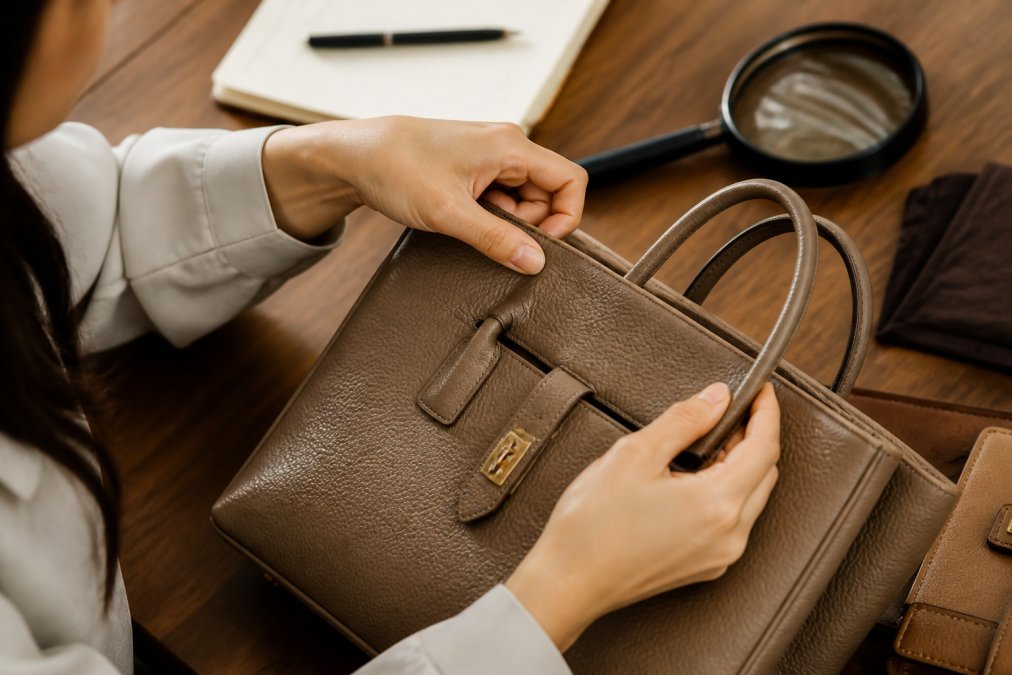
The Grain and the Press Test
Authentic leather should feel supple yet firm, and pressing on it should create a slight 'orange peel' texture that returns to smooth. Synthetic leather often feels overly smooth, plastic-like, or sticky. A more advanced check is the 'press and release' test on the bag's base or side panel: genuine leather shows a subtle, temporary indentation that fades within seconds, while faux leather will either resist the press entirely or show a permanent crease.
The Edge Paint and Glazing Test
Luxury brands spend significant time on edge painting, the colored coating applied to the raw edges of leather handles, straps, and flaps. On an authentic bag, the edge paint is applied in multiple thin layers, resulting in a smooth, even, and slightly rounded finish that is flush with the leather. Run your fingernail along the edge. If you feel bumps, unevenness, or see paint that has bled onto the leather surface, it is a fake. Counterfeiters often apply a single thick layer that cracks or chips easily.
Logo Placement and Typography: The Devil is in the Details
Brands are obsessive about the alignment, spacing, and font style of their logos. Check that the logo is perfectly centered and that the font matches the brand's official typography exactly, as counterfeiters often use a slightly bolder or thinner font noticeable on close inspection.
A less-known but highly effective check is the 'spacing test.' On authentic bags, the spacing between letters and the logo's distance from the bag's edges or seams is consistent and proportional. Counterfeiters often get the font close but fail on the kerning. For example, on an authentic Louis Vuitton 'LV' monogram, the two letters overlap in a specific, precise way. On a fake, the overlap is often slightly off.
The Interior Lining and the 'Hidden' Details
The interior lining and the dust bag are also telling indicators. Authentic bags use high-quality cotton or microfiber linings with a precise print, while fakes often use thin, shiny polyester. The included dust bag and authenticity card should feature crisp, high-quality printing without any smudging or misspellings.
A unique angle most guides miss is the 'interior pocket seam' check. On many authentic bags, the interior pocket is sewn with a specific stitch pattern that mirrors the exterior, and the pocket's depth is proportional to the bag's overall dimensions. Counterfeiters often make the interior pockets shallower or use a simpler stitch pattern. Also, check the zipper tape, the fabric strip next to the zipper teeth. Luxury brands use a tightly woven, branded zipper tape, whereas fakes often use a generic, loosely woven tape that frays easily.
The Smell Test and Other Chemical Indicators
Your nose is a surprisingly effective tool for authentication. A new authentic leather bag has a rich, clean, and slightly sweet smell of quality tanning. Counterfeit bags often emit a strong, chemical odor of glue, plastics, or cheap dyes that can be overwhelming and even cause a headache.
The smell test works well for new bags, but it is less reliable for vintage pieces, where the original scent has faded. For those, look for chemical indicators in the materials themselves. The glue used to bond the lining and structure of a genuine bag is applied carefully and is rarely visible. On a fake, you may find areas where the lining is lifting, or you might see or smell the adhesive.
Digital Authentication: NFC Chips and Microchips
The newest frontier in the fight against counterfeits is digital authentication, with brands embedding NFC chips and microchips directly into their products. Many high-end brands like Gucci, Prada, and Chanel now include a microchip that can be scanned with a smartphone to verify authenticity and access the product's digital history.
This technology is a game-changer. A scan can confirm the bag's style, color, and unique identifying information, tying it directly to the brand's database. However, this method is not foolproof, as counterfeiters have begun to embed fake or non-functional chips. A chip that fails to scan is a definite red flag, but a chip that scans successfully is not a guarantee of authenticity unless the information it returns matches the physical bag perfectly and is verified through the brand's official app.
When to Use Designer Bag Authentication Services
If a bag passes your visual inspection but you still have doubts, or if you are buying a high-value vintage piece, it is wise to use a professional designer bag authentication service. These services employ experts who have handled thousands of bags and can spot subtle inconsistencies the average shopper would miss.
Professional authentication is particularly important for online purchases, where you cannot physically inspect the bag before buying. Services typically require you to submit detailed photos, including close-ups of the stitching, hardware, logos, and serial numbers, and they provide a certificate of authenticity within a few days. The cost is a small price to pay for peace of mind compared to the potential loss of purchasing a convincing counterfeit.
Your Step-by-Step DIY Photo Guide for Remote Authentication
When you cannot inspect a bag in person, a systematic set of high-resolution photos is your best defense. This guide will help you gather the evidence needed to make a judgment call or send to a professional authentication service.
- Photograph the full bag: Take a clear shot of the front, back, and both sides of the bag in natural lighting.
- Capture the hardware: Get close-up shots of all zippers, clasps, and metal feet, focusing on the weight and clarity of any engravings.
- Document the logo: Photograph the logo on the exterior, interior, and any hardware, ensuring the font and alignment are legible.
- Detail the stitching: Take macro shots of the seams, focusing on the stitch density and thread quality.
- Locate and shoot the serial number: Find the serial or date code and take a clear, in-focus photo of the entire code and its surrounding area.
- Inspect the interior: Photograph the lining, the interior pockets, and the brand label or tag.
- Review the details: Look at your photos on a large screen, zooming in on the edges and corners to spot any inconsistencies.
This DIY approach is a powerful screening tool. If the photos reveal any common signs of counterfeit handbags, such as sloppy stitching or shallow engravings, you can confidently walk away from the sale. For bags that pass this remote inspection, you can then decide whether to proceed with the purchase or seek a second opinion from a professional service.
Authenticating a designer bag requires patience and a keen eye, but the reward is owning a piece of true craftsmanship that will last for years. At Tools, Handbags, and More, we understand the importance of authenticity, which is why we offer a curated selection of new and pre-loved designer handbags, each carefully inspected and sourced to meet high standards. Whether you are looking for a new Kate Spade tote or a pre-loved Coach shoulder bag, our custom sourcing service can help you find the specific authentic piece you are searching for. Get started with Tools, Handbags, and More and shop with confidence.

Frequently Asked Questions
What is the most faked luxury brand?
Louis Vuitton consistently ranks as the most counterfeited luxury brand worldwide. Its monogram canvas is widely replicated. Other frequently faked brands include Chanel, Gucci, and Coach. Because these brands are so commonly copied, buyers should pay extra attention to stitching, hardware, and date codes when purchasing them secondhand or from discount retailers.
Is there a free online service to check the authenticity of a bag?
A few free online forums and Facebook groups allow users to post photos for community feedback on authenticity. Results vary, since members are volunteers, not certified experts. For a binding opinion, paid designer bag authentication services remain the most reliable option. These services employ trained authenticators who examine high-resolution photos of stitching, hardware, and serial numbers against brand standards.
What should I look for in the stitching of an authentic designer bag?
Authentic designer bags feature even, tight stitches with consistent tension throughout. Look for clean starts and stops, no loose threads, and no skipped stitches. Fakes often show uneven spacing, crooked lines, or thread that frays easily under light pressure.
How do professional authenticators verify designer bags?
Professional authenticators combine visual inspection with brand-specific knowledge. They examine hardware weight and engravings, check logo font and spacing against brand standards, and verify serial numbers or date codes. Many also use UV light to detect material inconsistencies and check for RFID chips or NFC tags in newer models. Their training covers hundreds of details unique to each luxury house.
This article was written using GrandRanker