

How to Verify Authentic Limited Edition Drinkware
Table of Contents
- Why Authentic Limited Edition Drinkware Matters
- Step 1: Examine Manufacturer Markings and Base Stamps
- Step 2: Inspect Material Quality and Finish
- Step 3: How to Spot Fake Stanley Tumblers
- Step 4: Verify Packaging, Labels, and Serial Numbers
- Step 5: Buy from Authorized Retailers for Limited Edition Drinkware
- Step 6: Navigate the Secondary Market Safely
- Frequently Asked Questions
Last Updated: October 2, 2026
Why Authentic Limited Edition Drinkware Matters
Limited edition drinkware is a small-batch run of cups, tumblers, or bottles with a design, color, or finish that will not be produced again.
The gap between a real release and a replica comes down to a handful of physical details most buyers never check.
Counterfeiters copy shape and color but rarely match the base stamp, laser-etched markings, weight, or lid seal. Those small differences are your best proof.
Step 1: Examine Manufacturer Markings and Base Stamps
Start with the bottom of the cup. Real manufacturers stamp or etch their brand, size, and origin into the base itself, not onto a sticker.
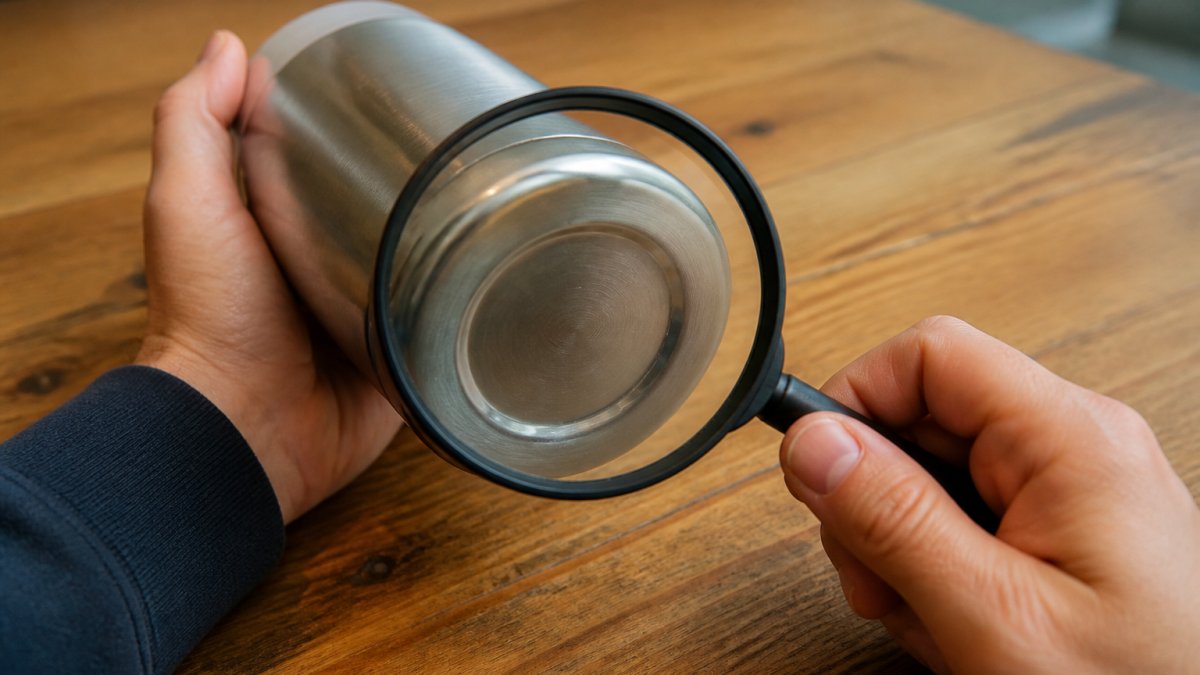
Turn the tumbler upside down under good light and look for a clean, crisp logo with even spacing: lettering sits straight and edges are sharp.
A few things to check on the base:
- Brand name spelled correctly, with no missing letters
- Size, capacity, and country of origin listed
- A recycling logo with the correct material code
- A serial number or batch code, if the brand uses one
Fakes often get the font wrong. Letters may be too thick, too thin, or spaced unevenly. Some skip the recycling logo entirely.
Step 2: Inspect Material Quality and Finish
A real limited edition piece feels solid and looks even from every angle; a fake shows its flaws the moment you run your thumb across the surface.
Stainless Steel and Vacuum-Insulated Construction
Genuine stainless steel tumblers use vacuum-insulated walls to hold temperature for hours; knockoffs skip the vacuum layer or use thin steel that dents easily.
Press the cup gently with your thumb. Real steel flexes almost none. Thin metal gives under light pressure.
Check heat retention too: a real vacuum-insulated cup keeps ice for hours, while a fake loses its chill fast.
Paint, Coating, and Straw Transparency
Run your finger along the seam where the coating meets the rim. Genuine finishes feel smooth and even; fakes have rough patches, bubbles, or drips.
Now look at the straw. Clear straws on real products are see-through with no cloudiness. Cloudy, yellowed, or brittle straws point to cheap plastic.
Step 3: How to Spot Fake Stanley Tumblers
Stanley tumblers are among the most copied cups on the market. Spotting fakes comes down to a short list of tells you can check in a store or on a doorstep.
Common Counterfeit Indicators
Watch for these signs:
- Logo font that is slightly off or the wrong weight
- Bear logo missing detail or facing the wrong way
- Color that looks flat compared to official photos
- Handle that wobbles or feels loose in the hand
- Screws or hardware that look cheap or stripped
Any single issue might be a manufacturing defect. Two or more together almost always mean a dupe.
Weight, Balance, and Lid Seal Checks
Pick up the cup and roll it in your palm. A real tumbler feels balanced, with weight centered in the body; fakes feel top-heavy or hollow.
Next, fill the cup with water and turn it upside down. A genuine lid seal holds tight with no drips; a fake lid may leak at the rim or pop loose.
Step 4: Verify Packaging, Labels, and Serial Numbers
Packaging is where fakes cut the most corners, and it is where the strongest verification tool lives: the serial number. Digital serial verification is the one check counterfeiters cannot easily fake at scale.
What a Real Box and Label Look Like
Real limited edition products ship in branded boxes with clean printing and matching labels. Look for:
- Box printing that is sharp, not blurry or faded
- A label whose product name, colorway, and size match the item inside
- A serial number or batch code printed on the box, not handwritten or stickered over
- Care instructions and safety text in clear English, with no typos or awkward phrasing
- A tamper seal or shrink wrap that shows no signs of being re-applied
Match the serial number on the box to any code on the product itself. A mismatch is a hard stop, counterfeiters often reuse one valid code across hundreds of units.
How Digital Serial Verification Actually Works
A serial number is only useful if you can cross-reference it. Here is the process:
- Locate the code on the product. On most insulated tumblers it is laser-etched near the base rim or under the lid gasket. Photograph it under bright, angled light so the etching is readable.
- Find the brand's verification channel. Check the brand's official website footer for a "Product Verification," "Authenticity," or "Warranty Registration" link. Some brands route verification through a mobile app instead of a web form.
- Enter the code exactly as printed. Watch for look-alike characters: the numeral 0 versus the letter O, the numeral 1 versus the letter I. A single wrong character will return a false "not found."
- Read what the tool returns. A legitimate result typically confirms the product line, the production batch, and sometimes the original retail channel. A result that only says "valid" with no product detail is a weak signal.
- Check for duplicate-use flags. Some brand portals warn you if a code has already been registered by another user. That warning is one of the clearest signs you are holding a counterfeit or a resold return.
When the Brand Has No Lookup Tool
Many smaller drinkware brands do not run a public verification portal. In that case:
- Email or call customer service with the serial number, the product name, and a photo of the base stamp. Ask them to confirm the batch and the production date.
- Request the response in writing (email, not a phone call) so you have a record if you later need to file a dispute.
- Ask specifically whether the code corresponds to a limited edition run or a standard production line. Some counterfeiters copy a real code from a mass-produced item and apply it to a limited edition shell.
Step 5: Buy from Authorized Retailers for Limited Edition Drinkware
The simplest way to avoid fakes is to buy from authorized retailers for limited edition drinkware.
Check the brand's own website for a store locator or an approved seller list. If a shop is not on that list, treat it with caution.
A few rules to follow:
- Buy from brand-owned stores or their listed partners
- Avoid listings that show stock photos instead of real product shots
- Be wary of prices far below the official retail price
- Ask for a receipt that names the seller and the item
At Tools, Handbags, and More, our custom sourcing service helps you track down specific limited edition items that are not in our current catalog.
Step 6: Navigate the Secondary Market Safely
The resale market is where most fakes change hands, and where the standard advice, "ask for photos, pay safely", falls apart. Safe buying on peer-to-peer marketplaces comes down to three mechanisms: escrow, platform dispute windows, and payment-method chargeback rules. Understand all three before you send money.
What to Ask the Seller Before You Pay
Request these items in writing through the platform's messaging system, not a side text or email. Platform messages are admissible in a dispute; off-platform chats usually are not.
- Clear, dated photos of the base stamp, lid gasket, straw, and serial number
- A short video of the lid sealing and the cup holding water upside down
- Proof of original purchase: a receipt, order confirmation email, or warranty registration
- The exact return policy in writing, including who pays return shipping
- Confirmation that the serial number has not already been registered to another account
If a seller refuses any of these, treat the listing as a pass. Legitimate sellers of limited editions expect these questions.
Escrow and Buyer-Protection Mechanisms
Escrow services hold your payment until you confirm the item matches the listing. On peer-to-peer marketplaces, the platform often acts as escrow agent: your money sits with it until you mark the item as received and as described. Key points:
- Dispute windows are short. Most major marketplaces give you a fixed number of days after delivery to open a case, often three to thirty days depending on the platform. Inspect the item the day it arrives, not the following weekend.
- "Item not as described" is a stronger claim than "I changed my mind." Document the specific mismatch: photograph the fake base stamp next to the listing photo, note the serial number that failed verification, and cite the exact listing claim that was false.
- Escrow only protects you if you keep the transaction on-platform. The moment a seller asks you to move payment to a cash app, a gift card, or a direct bank transfer, you lose escrow protection entirely. That request is itself a red flag.
Payment-Method Chargeback Rules
If you pay with a credit card, even through a marketplace, federal law gives you the right to dispute charges for goods not delivered as described. The Fair Credit Billing Act covers most consumer credit cards, and most major card networks extend similar protections to debit transactions. Practical implications:
- Credit cards generally offer the strongest chargeback rights. Use them for high-value limited editions.
- Peer-to-peer cash apps typically offer no chargeback. Once the money leaves, it is gone.
- Bank transfers and wire services are effectively irreversible. Avoid them for any purchase where authenticity is uncertain.
- Keep every message, photo, and receipt. A chargeback claim without documentation is usually denied.
After the Item Arrives
Run every check in this guide before you leave feedback or close the transaction. If the item fails:
- Photograph the failure points immediately, in the same lighting and angles as the listing photos.
- Open a dispute through the platform before the window closes.
- If the platform denies the claim, file a chargeback with your card issuer and attach the platform correspondence.
- Keep all packing materials, the box, and the shipping label. They are evidence of the chain of custody.
Frequently Asked Questions
How do I know if my Stanley is real?
Check the base stamp for clear, laser-etched manufacturer markings and a recycling logo. Authentic Stanley tumblers have consistent font alignment and no spelling errors. Inspect the lid seal and straw transparency; fakes often use cloudy straws or ill-fitting lids. Weigh the tumbler; genuine ones feel balanced. If you bought from an unauthorized seller, verify the serial number with Stanley's customer service.
What are the common signs of counterfeit drinkware?
Look for fuzzy or misaligned logos, uneven paint, and a strong chemical odor. Counterfeit limited edition drinkware often has packaging with poor print quality or missing batch codes. The weight may be lighter due to thinner stainless steel. Straws might be less transparent. If the price seems too low for a limited edition, it's likely a dupe. Always buy from authorized retailers to avoid these issues.
How do serial numbers help verify drinkware authenticity?
Serial numbers and batch codes allow you to trace a product's manufacturing origin. Authentic limited edition drinkware typically has a unique serial number laser-etched on the base or printed on the packaging. You can contact the manufacturer to confirm if that number matches their records. Some brands offer online verification tools. If the serial number is missing, duplicated, or doesn't match the model, it's a red flag for a counterfeit.
Why is it important to buy drinkware from authorized retailers?
Authorized retailers for limited edition drinkware source directly from the manufacturer, ensuring authenticity and quality control. They also provide valid receipts for warranty claims and returns. Buying from unauthorized sellers increases the risk of receiving a counterfeit, which may have manufacturing defects, poor heat retention, or unsafe materials. Authorized retailers also comply with consumer protection laws, giving you recourse if something goes wrong.
Fakes are getting better every year, which makes buying limited edition drinkware a real risk if you shop blind. Tools, Handbags, and More takes that risk off your plate with a custom sourcing service that hunts down specific items, personalized help from a real person, and access to a wide range of product categories in one place. Get started with Tools, Handbags, and More and shop limited editions with confidence.