

Professional Power Tools List: 10 Tools Pros Rely On
Table of Contents
- Why a Professional Power Tools List Saves You Money
- Quick Comparison: Professional Power Tools and Prices
- Essential Power Tools for Contractors
- Power Tools for Woodworking
- Cordless vs. Corded Power Tools: Which Should You Choose?
- Professional Power Tool Buying Guide
- Safety and Maintenance for Professional Tools
- Conclusion: Building Your Professional Power Tools List
- Frequently Asked Questions
Last Updated: October 8, 2026
Why a Professional Power Tools List Saves You Money
Building a professional power tools list before you buy is the difference between a kit that earns its keep and a garage full of regret.
A professional power tools list is a prioritized inventory of the tools a trade or project genuinely requires, ranked by how often you will use them and how much time each one saves.
Quick Comparison: Professional Power Tools and Prices
Here is a quick look at the tools we stock most often for trade work, with current prices so you can plan a budget in one pass.
| Tool | Price | Best For | Power Source |
|---|---|---|---|
| DEWALT 20V MAX XR Hammer Drill | $185.00 | Drilling wood, metal, masonry | Cordless |
| DEWALT DCH133 SDS-Plus Rotary Hammer | $225.00 | Concrete and masonry drilling | Cordless |
| DEWALT DCF900B 1/2 in. Impact Wrench | $219.00 | Heavy fastening, lug nuts | Cordless |
| DEWALT 6-1/2 in. Circular Saw | $179.00 | Framing, plywood, sheet goods | Cordless |
| DEWALT 11 Amp Angle Grinder | $85.00 | Grinding, cutting, rust removal | Corded |
| DEWALT Drywall Screwgun DCF630 | $154.99 | Hanging drywall fast | Cordless |
| DEWALT Oscillating Tool DCS356 | $119.00 | Trim, plunge cuts, sanding | Cordless |
| DEWALT ATOMIC Impact Driver | $99.00 | Driving screws in tight spaces | Cordless |
| DEWALT 20V XR Variable Speed Grinder | $249.00 | Metal, masonry, surface prep | Cordless |
| Ryobi ONE+ HP Brad Nail Gun | $119.00 | Trim and furniture fastening | Cordless |
Essential Power Tools for Contractors
For contractors, the non-negotiable core is drilling, fastening, cutting, and grinding capability. Everything else is a specialization you add once the basics are covered.

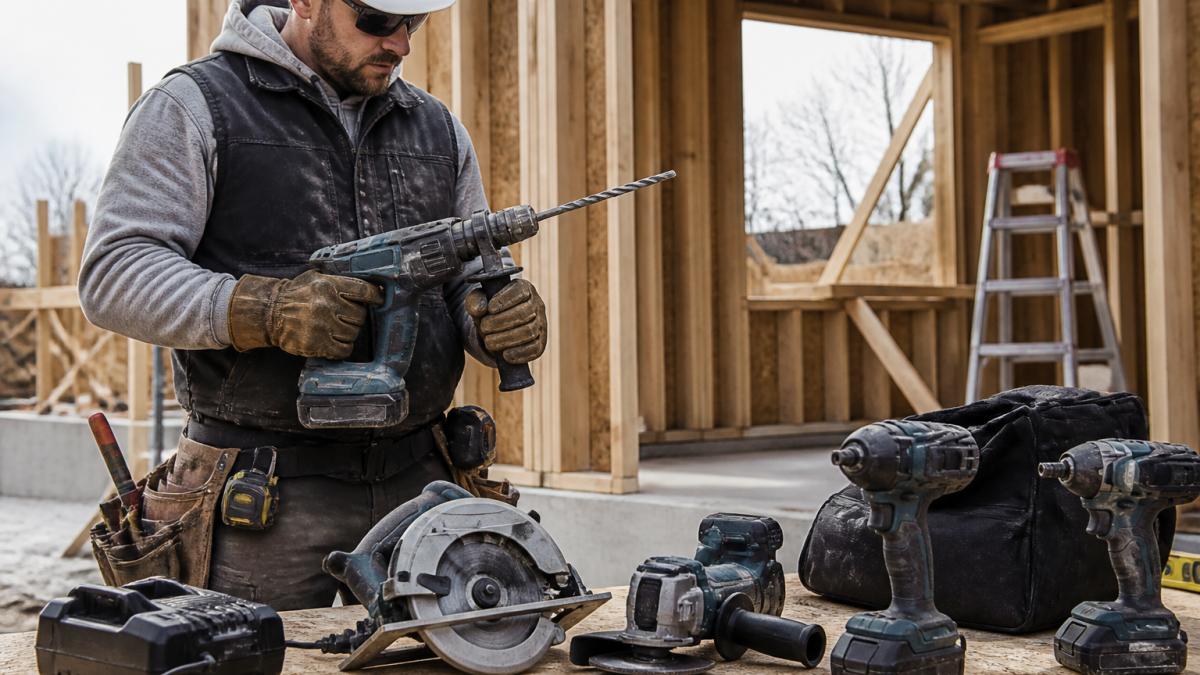
Drilling and Fastening Tools
A hammer drill handles wood, metal, and masonry with one tool. The DEWALT 20V MAX XR Brushless 1/2 in.
For concrete, step up to the DEWALT DCH133 SDS-Plus Rotary Hammer. The 1-inch SDS-Plus bit system makes changes fast, and the brushless motor keeps performance steady under load.

Fastening splits into two jobs. The DEWALT ATOMIC 1/4 in. Impact Driver is compact enough for tight spaces, while the DEWALT DCF900B 1/2 in.
Cutting and Demolition Tools
The DEWALT 6-1/2 in. Sidewinder Circular Saw cuts plywood and framing lumber cleanly, and the sidewinder balance keeps control in long cuts. For grinding, cutting, and rust removal, the DEWALT 11 Amp Corded Angle Grinder brings steady power from an outlet, which suits shop work. If you need to move around a site, the DEWALT 20V XR Variable Speed Grinder lets you match speed to metal, masonry, or wood.
Power Tools for Woodworking
Woodworking rewards precision over raw power. The tools below cover the cut, the detail, and the finish.
Saws and Cutting Tools for Wood
A circular saw is the workhorse for breaking down sheet goods and framing lumber. The 6-1/2 inch blade on the DEWALT cordless saw handles plywood and dimensional lumber without bogging down. For plunge cuts and flush trimming, the DEWALT Oscillating Tool reaches spots a circular saw cannot.
Sanding and Finishing Tools
The same oscillating tool sands in corners and along edges where a random orbital sander will not fit. At 2.33 lbs and 11.2 inches long, it stays controllable during long finishing sessions. For fastening trim and furniture, the Ryobi ONE+ HP 18V Brad Nail Gun drives 18-gauge nails cleanly and runs cordless.
Cordless vs. Corded Power Tools: Which Should You Choose?
The corded-versus-cordless question is not a brand preference, it is a math problem about runtime, amperage, and where the tool actually sits during a workday. Most professional power tools lists skip this and just tell you to "go cordless." That advice breaks down the moment you are running a 7-inch grinder for six hours straight.
The Four Variables That Actually Decide It
1. Duty cycle. Duty cycle is how long a tool can run before it needs to cool.
2. Runtime per charge. A 20V MAX XR 5.0Ah pack driving a hammer drill typically delivers enough holes for a residential rough-in day.
3. Amperage and sustained torque. Corded tools are rated in amps, a 15-amp circular saw or an 11-amp angle grinder holds its speed under load in a way a battery tool cannot match at the same price.
4. Worksite conditions. No outlet on a framing deck, a roof, or a service call means cordless is the only practical answer.
A Simple Decision Framework
| Situation | Better Choice | Why |
|---|---|---|
| Drilling, driving, and fastening around a site | Cordless | Mobility, quick setup, one battery platform |
| Cutting sheet goods on a deck or roof | Cordless | No power run, safe footing |
| Production sanding or long grinding passes | Corded | Continuous duty, no thermal cutoff |
| Bench work in a fixed shop | Corded | Lower upfront cost, unlimited runtime |
| Concrete drilling and demolition | Cordless SDS-Plus or corded SDS-Max | Match the hammer class to the hole size |
| Trim and finish work | Cordless | Lightweight, low draw, easy to maneuver |
The Battery Platform Trap
The hidden cost in cordless is the platform. Batteries and chargers often cost as much as the bare tools, and once you commit to a voltage class you are locked in for years. A common pattern among contractors is to standardize on one 18V or 20V platform for drills, drivers, saws, and lights, then keep a small set of corded tools for the high-draw jobs that platform cannot sustain.
NEW DEWALT20V MAX XR Brushless Cordless 1/2 in. Hammer Drill (Tool Only) P-017 →
Professional Power Tool Buying Guide
A professional power tool buying guide comes down to two decisions: which battery system you commit to, and how much motor quality you pay for.
Battery System and Compatibility
Battery compatibility is the single biggest factor in long-term cost. A 20V MAX XR lithium-ion platform lets one battery pack serve a drill, saw, grinder, and screwgun. Brushless motors draw less current, so each charge lasts longer.
Stick to one voltage class per platform. Mixing brands means buying duplicate batteries and chargers, which erases any savings from a lower sticker price.
Motor Technology and Durability
Brushless motors outlast brushed ones because there are no carbon brushes to wear out. They also run cooler and deliver more runtime per charge, which matters on a full day of drilling or grinding. Durability comes down to motor quality and how well the tool manages heat under load.
Safety and Maintenance for Professional Tools
Safety and maintenance are the two topics most professional power tools lists skip entirely. They are also the two that determine whether a tool lasts five years or five months. This section covers both as a structured routine you can run before, during, and after each shift.
Pre-Use Inspection
Run this check at the start of every shift, not once a week:
- Cords and plugs. Look for nicks, exposed conductors, and a missing ground pin on corded tools. A damaged cord is the most common cause of shock incidents on a jobsite.
- Battery packs. Check for swelling, cracked housings, or corrosion on the terminals. A swollen lithium-ion pack should be removed from service immediately, do not attempt to charge it.
- Guards. Confirm the lower blade guard on a circular saw retracts freely and snaps back. A stuck guard is a kickback waiting to happen.
- Blades and bits. A dull blade forces you to push harder, which increases kickback risk. Replace rather than force.
Personal Protective Equipment by Tool Type
| Tool | Minimum PPE |
|---|---|
| Circular saw, reciprocating saw | Safety glasses, hearing protection, dust mask |
| Angle grinder, cut-off tool | Face shield over safety glasses, hearing protection, leather gloves, long sleeves |
| Hammer drill, rotary hammer | Safety glasses, hearing protection, dust mask or respirator for silica |
| Impact driver, impact wrench | Safety glasses, hearing protection |
| Brad nailer, finish nailer | Safety glasses, hearing protection |
Grinding and cutting metal throw sparks and fragments at high speed, a face shield over safety glasses is the standard, not an upgrade. Concrete drilling generates respirable crystalline silica, so a properly fitted respirator matters as much as the drill itself.

Blade, Disc, and Bit Matching
Match the accessory to the tool's rated size and maximum RPM. An angle grinder rated at 11,000 RPM with a disc rated at 8,500 RPM is a failure waiting to happen, the disc can shatter.
For SDS-Plus and SDS-Max rotary hammers, use the correct shank type. Forcing an SDS-Plus bit into an SDS-Max chuck damages the chuck and the bit.
Battery Care and Storage
Lithium-ion packs lose capacity when stored at temperature extremes. A common pattern is to keep packs in a climate-controlled area rather than a hot truck cab or a freezing trailer. Store packs at roughly 50 to 80 percent charge for long-term storage, and avoid leaving them on the charger indefinitely after they reach full.
Maintenance Cadence
- After every use: Wipe down the tool, clear dust from motor vents, and inspect the cord or pack.
- Weekly: Check blade and bit sharpness, tighten guard hardware, and test triggers.
- Monthly: Inspect brushes on brushed tools, check chuck runout, and clean or replace filters on dust extraction.
- Annually: Have high-use tools serviced, bearings, switches, and cords are the usual wear points.
Conclusion: Building Your Professional Power Tools List
Building a professional power tools list is a sequencing problem: cover drilling and fastening first, add cutting and grinding next, then fill in woodworking and finishing tools as the work demands.
When a specific model is not on our shelves, our custom sourcing service tracks it down for you. We carry many product categories, offer personalized assistance in finding specific items, and help you build a kit that matches your trade instead of a generic starter set.
Frequently Asked Questions
What power tools should a professional contractor own?
A professional contractor needs a core set: a hammer drill or rotary hammer for masonry, an impact driver for fastening, a circular saw for framing and cutting, an angle grinder for metalwork and surface prep, and an oscillating tool for detail work. Our professional power tools list includes the DEWALT 20V MAX XR Hammer Drill at $185 and the DCH133 Rotary Hammer at $225. Start with the tools your trade uses daily, then expand into specialty equipment.
Should professionals choose cordless or corded power tools?
It depends on the job. Cordless tools like the DEWALT 20V MAX system run on Li-ion battery packs and give you freedom of movement on site, which matters for contractors working in multiple locations. Corded tools such as the DEWALT 11 Amp Angle Grinder at $85 deliver constant power for extended grinding or cutting sessions. Many pros keep both: cordless for mobility, corded for heavy-duty stationary tasks.
What should I look for when buying professional power tools?
Focus on four things: motor type, battery system, build quality, and the accessories available. Brushless motors last longer and run cooler than brushed versions. A shared battery platform like DEWALT 20V MAX means one charger and one set of packs powers your entire kit. Check that the tool accepts standard cutting discs, bits, and attachments. Our professional power tool buying guide covers these criteria in detail.
Are professional power tools worth the extra cost?
For daily use, yes. Professional-grade tools use brushless motors and higher-grade components that handle repeated jobsite abuse. A $99 DEWALT ATOMIC Impact Driver or a $179 Circular Saw costs more upfront than budget alternatives, but the runtime, durability, and battery compatibility reduce replacement costs over time. If you use a tool weekly or more, the investment pays off.
Which power tools are most useful for woodworking?
Woodworkers rely on a circular saw for breaking down plywood and lumber, an oscillating tool for flush cuts and sanding in tight spots, and a brad nail gun for assembling furniture and trim. The DEWALT 6-1/2 in. Circular Saw at $179 and the Ryobi ONE+ HP 18V Brad Nail Gun at $119 are solid starting points. Add a random orbit sander and a router as your projects grow.