

Tactical Backpack vs Messenger Bag for Work in 2026
Table of Contents
- Tactical Backpack vs Messenger Bag for Work: Quick Comparison
- Ergonomics of Backpacks vs Messenger Bags: Shoulder Strain and Weight Distribution
- Storage Volume and Organization: Compartmentalization That Works
- The Best Tactical Backpack for Office Use: What to Look For
- EDC Bag Essentials for Professionals: What Actually Belongs in Your Carry
- Professional Dress Code Compatibility and Security Features
- Weatherproofing, Durability, and Daily Commute Realities
- Conclusion: Which Carry Wins for Your Workday?
- Frequently Asked Questions
Last Updated: September 20, 2026
Tactical Backpack vs Messenger Bag for Work: Quick Comparison
The tactical backpack vs messenger bag for work debate comes down to one question: how much weight will you carry, and for how long? A messenger bag keeps quick access within reach and reads more business casual, while a backpack spreads load across both shoulders and holds more without strain. This guide from Tools, Handbags, and More breaks down ergonomics, storage, durability, and dress code fit so you can pick the right daily carry.
| Factor | Tactical Backpack | Messenger Bag |
|---|---|---|
| Weight distribution | Both shoulders, padded back panel | One shoulder, cross-body strap |
| Quick access | Slower, requires removing bag | One-motion reach while walking |
| Storage volume | High, multiple compartments | Moderate, flatter form factor |
| Professional aesthetic | Depends on design and color | Naturally business casual |
| Best for | Heavy loads, tech-heavy carry | Light loads, short commutes |
Ergonomics of Backpacks vs Messenger Bags: Shoulder Strain and Weight Distribution
Ergonomics is the deciding factor for most commuters, and it favors backpacks once your load gets heavy. A backpack distributes weight across both shoulders and the back through a padded back panel, which reduces shoulder strain. A messenger bag concentrates the same weight on one shoulder, and the cross-body strap pulls unevenly as you walk.
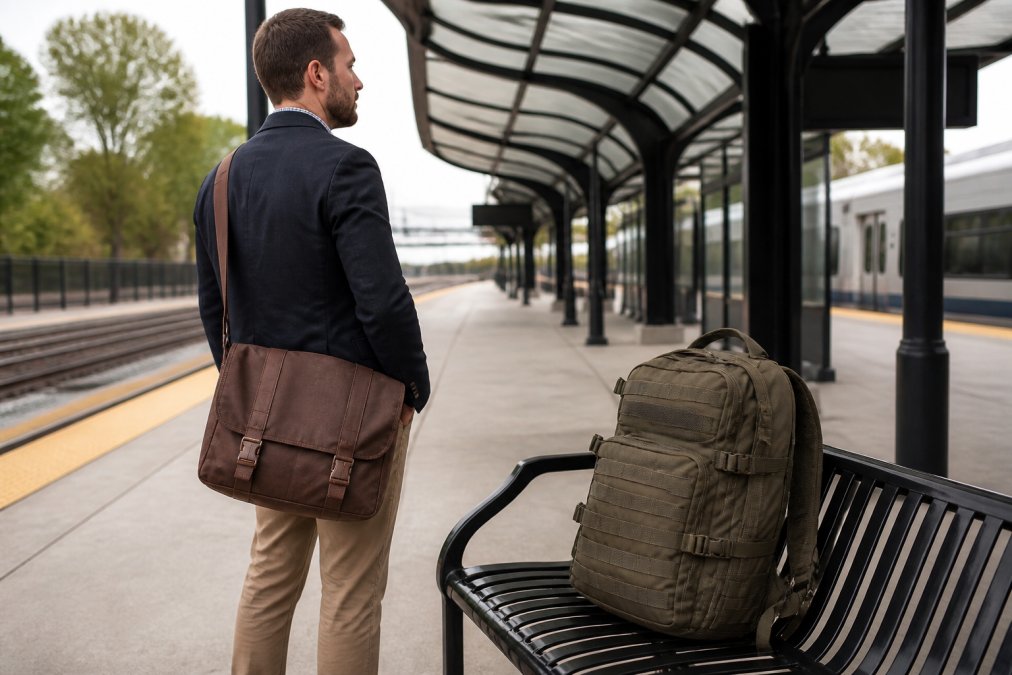
That imbalance shows up in daily carry habits. People who carry a messenger bag for long distances often shift it from shoulder to shoulder, which affects stability and posture. Backpacks keep the load centered, so maneuverability stays consistent whether you're walking several blocks or standing on transit.
The trade-off is access. A messenger bag offers one-motion reach: you can grab a phone or transit card without taking the bag off. A backpack usually requires removing it or swinging it to one side. If your daily commute involves frequent stops, that difference matters more than perfect weight distribution.
Storage Volume and Organization: Compartmentalization That Works
Storage volume and organization separate these two carry styles more than any other factor. A tactical backpack typically offers higher load capacity with dedicated compartmentalization: laptop sleeve, front zip pocket, and a main compartment for bulkier items. A messenger bag stays flatter, which limits how much you can carry but keeps everything within easy reach.
For a tech-heavy daily carry, look for a padded laptop sleeve that matches your device size. A sleeve that's too loose lets the laptop slide, and one that's too tight strains the zipper.
The Best Tactical Backpack for Office Use: What to Look For
A tactical backpack can absolutely work in an office, but only if you shop for the right signals. The features that make a pack great in the field, external webbing, molle panels, high-contrast hardware, camo or ranger-green colorways, are the same features that read as out of place in a client meeting or a business casual floor. The fix is not to abandon tactical construction; it is to prioritize the tactical traits that stay invisible.
Here is the framework most buyers skip:
- Silhouette over surface. A clean, boxy profile with a single front panel reads more professional than a pack covered in straps and attachment points. If you want molle, look for laser-cut or low-profile webbing that sits flush against the fabric.
- Color discipline. Black, charcoal, navy, and dark olive are the safest. Bright tan, coyote brown, and multi-cam are the fastest way to make a pack look like gear instead of a work bag.
- Hardware tone. Matte black or gunmetal zippers and buckles disappear against dark fabric. Polished chrome or brass pulls draw the eye and push the bag toward casual.
- Laptop protection as a hard requirement. A dedicated, padded, suspended sleeve, one where the laptop does not rest on the bottom of the bag, protects against the drop that happens when you set the pack down harder than you meant to. Suspension matters more than sleeve thickness.
- Back panel and strap padding. A mesh or ventilated back panel reduces the sweat patch that shows through a dress shirt on a warm commute. Padded, contoured straps distribute load without digging into a collared shirt.
- Luggage pass-through. A strap on the back that slides over a rolling suitcase handle is the single most useful feature for hybrid workers who travel between office and airport.
EDC Bag Essentials for Professionals: What Actually Belongs in Your Carry
EDC bag essentials for professionals should match your actual workday, not a hypothetical emergency. Most people overpack, then wonder why their shoulder hurts by mid-afternoon.
New Coach Green Monogram Backpack →
A practical professional carry usually includes:
- Laptop and charger, in a correctly sized sleeve
- Phone, wallet, and keys in a quick-access pocket
- A slim notebook or tablet for meetings
- A compact umbrella for weather resistance on the commute
- One cable pouch, not a tangle of loose cords
- A water bottle only if your bag has a secure side pocket
Professional Dress Code Compatibility and Security Features
Professional dress code compatibility is where messenger bags have a clear edge, and most buying guides skip it entirely. A messenger bag sits naturally against business casual and formal attire. A tactical backpack can look out of place in a client-facing office unless the design is understated.
Look for these security features when comparing options:
- Zipper closures rather than open tops
- A flap with a turn-lock or magnetic snap for extra coverage
- Interior zip pockets that keep valuables off the main compartment floor
- Dark, low-contrast colors that don't advertise what you're carrying
- Zipper pulls that tuck into a garage or loop, so a pickpocket cannot grab and open them in one motion
- A back-facing or hidden pocket for a phone or transit card, so you are not opening the main compartment in a crowd
- RFID-blocking lining in a card pocket if you carry contactless cards, since a reader can skim a card through fabric
Weatherproofing, Durability, and Daily Commute Realities
Weatherproofing and durability decide how long a bag survives a real daily commute. Material density matters more than marketing claims: leather and dense faux leather resist light rain and hold their shape, while thin nylon soaks through and sags under load.
Conclusion: Which Carry Wins for Your Workday?
The tactical backpack vs messenger bag for work decision comes down to load and access. Backpacks win on ergonomics, storage volume, and travel versatility. Messenger bags win on quick access, professional aesthetic, and security in crowded spaces.
Frequently Asked Questions
Is a messenger bag more professional than a backpack?
It depends on your workplace. Messenger bags often read as more formal because they sit at the hip and look like a briefcase when carried. Backpacks, especially tactical styles with MOLLE webbing, can look casual or military-inspired. However, leather and monogram backpacks like the Coach Green Monogram Backpack (B-286) bridge that gap. In business casual offices, a clean backpack works fine. In strict corporate settings, a slim messenger or a leather backpack is the safer choice.
What should a professional carry in an EDC bag for work?
A practical EDC setup for professionals includes a laptop or tablet, a charger and cable, a notebook, pens, a water bottle, keys, a wallet, and any security badge. If you commute by transit, add a compact umbrella and a power bank. The key is compartmentalization: use a padded laptop sleeve, a front zip pocket for quick access items, and a main compartment for bulkier gear. A bag with a mesh back panel and adjustable shoulder straps keeps the load comfortable.
Are tactical backpacks appropriate for corporate environments?
Tactical backpacks are appropriate in casual, creative, or tech workplaces. Their MOLLE webbing, heavy-duty zippers, and rugged hardware signal function over form. In conservative corporate offices or client-facing roles, a tactical backpack may clash with dress codes. If you want the durability of a tactical bag without the military look, choose a leather or quilted backpack with a professional aesthetic, such as the bebe Quilted Mini Backpack in tan or black.
How do I choose the right bag for my daily commute?
Start with your commute type. Cyclists and walkers benefit from a backpack because it distributes weight across both shoulders and keeps hands free. Public transit commuters who need quick access to a card or phone may prefer a messenger bag that swings forward easily. Then check storage volume: a mini backpack holds essentials, while a full-size backpack fits a laptop, lunch, and gym clothes. Finally, match the material and style to your workplace dress code.
What is the point of a tactical backpack for work?
A tactical backpack is built for durability and organization. It typically has reinforced stitching, heavy-duty zippers, multiple compartments, and MOLLE webbing for attaching pouches. For work, the benefit is load capacity and compartmentalization: you can carry a laptop, tools, water bottle, and cables without everything shifting. The trade-off is weight and appearance. If your office is casual and you carry a lot of gear, a tactical backpack works well. If you need a polished look, a leather or quilted backpack is a better fit.