

Target Alternatives for Household Gear in 2026
Table of Contents
- Why Shoppers Look Beyond Target for Household Gear
- Best Online Home Goods Stores to Consider
- Affordable Home Decor Websites Worth Your Time
- Where to Buy Cheap Kitchen Appliances and Tools
- Comparing Cost, Selection, and Shipping Across Retailers
- When to Shop Online vs. In-Store for Household Items
- Custom Sourcing: Finding Specialty Items Beyond Standard Inventory
- Conclusion
Last Updated: August 16, 2026
Why Shoppers Look Beyond Target for Household Gear
Target once felt like the obvious choice for household essentials, but target alternatives for household gear have multiplied. Amazon offers unmatched speed and selection. Walmart undercuts on price. IKEA delivers design-forward furniture at budget prices. HomeGoods specializes in unique decor. Each retailer has carved out a distinct advantage, and savvy shoppers mix and match to get exactly what they need.
This guide from Tools, Handbags, and More breaks down the best target alternatives for household shopping, comparing where to find everything from kitchen appliances to home decor. Whether you're furnishing a new apartment, replacing worn-out essentials, or hunting for a specific item, you'll find a clearer path forward here.
Best Online Home Goods Stores to Consider

Amazon: Unmatched Selection and Speed
Amazon remains the largest online marketplace for household goods, offering everything from basic kitchen tools to specialty appliances and home decor. Prime membership delivers same-day options in metro areas and two-day standard shipping. Customer reviews provide transparency, and returns are straightforward. For shoppers prioritizing convenience and breadth, Amazon delivers, though overwhelming options and variable quality between sellers can complicate decisions.
Walmart: Budget-Friendly One-Stop Shopping
Walmart has aggressively built its online presence to compete with Amazon. For household essentials and home decor, it often undercuts competitors on price. Free shipping applies to orders over $35, and same-day delivery works in select metro areas. Walmart's strength lies in price consistency; the trade-off is a utilitarian shopping experience with limited premium or designer options.
Overstock: Designer Goods at Discount Prices
Overstock occupies a distinct niche: designer and brand-name furniture, rugs, and home decor at prices 20-40% below full retail. The online-only model keeps overhead low. The challenge is you can't physically inspect items before purchase, and shipping costs for large furniture can add significantly. Still, for specific pieces where you've researched quality and style, Overstock often wins on price.
Affordable Home Decor Websites Worth Your Time
HomeGoods: Treasure-Hunt Style Shopping
HomeGoods built its reputation on constantly rotating inventory, you never know exactly what you'll find, but when you do, it's usually a deal. This inconsistency makes it frustrating if you're hunting for something specific. HomeGoods works best when browsing for inspiration rather than checking off a list. The in-store experience remains stronger than online.
IKEA: Functional Furniture on a Budget
IKEA's Scandinavian design prioritizes functionality and affordability. The modular, ready-to-assemble approach keeps costs down. Most furniture requires assembly, which is either a feature (customization, lower cost) or a drawback (time investment). IKEA's showrooms provide inspiration and the chance to see items in person before ordering online.
Bed Bath & Beyond: Home Essentials with Frequent Sales
Bed Bath & Beyond focuses on bedding, bath, and kitchen essentials with regular sales and promotions. Pricing without sales can be higher than discount retailers, so timing matters: wait for sales or use digital coupons. Free shipping on orders over $49.99 makes it accessible for smaller purchases.
Where to Buy Cheap Kitchen Appliances and Tools
Kitchen appliances and tools represent a category where price-shopping pays dividends, but the cheapest option isn't always the best value.
National Discount Retailers: Speed and Consistency
Dollar General and Family Dollar offer household essentials, cleaning supplies, basic kitchen tools, and seasonal decor at extremely low price points. These retailers excel at sourcing private-label products and brand-name closeouts. The trade-off is selection and durability: you won't find specialty appliances or high-end tools, and items are designed for short-term use. These stores work for basics, cleaning supplies, storage solutions, and everyday kitchen items.
Local and Regional Alternatives: Hidden Value
National retailers dominate the conversation, but local sourcing often delivers better prices and quality for specific categories.
Farmers markets and co-ops: Many farmers markets and local food co-ops stock bulk dry goods, reusable containers, and kitchen tools at prices below retail chains. Buying in bulk reduces per-unit cost and packaging waste. Co-ops often offer member discounts on kitchen equipment.
Restaurant supply stores: Open to the public in most regions, restaurant supply stores (WebstaurantStore, local equivalents) sell commercial-grade kitchen tools, storage containers, and small appliances at wholesale prices. A commercial-grade mixing bowl can be found for various prices, depending on size and material. Quality is higher and longevity is often longer than consumer-grade equivalents.
Liquidation and overstock warehouses: Regional liquidation stores sell returned merchandise, overstock, and closeout items from major retailers at 40-70% discounts. Kitchen appliances, tools, and home goods rotate through inventory. Quality is typically excellent since items are often new or lightly used. The catch: inventory is unpredictable and selection changes weekly.
Thrift and second-hand stores: Goodwill, Salvation Army, and local consignment shops stock used kitchen tools, small appliances, and home goods at 50-80% discounts. A new KitchenAid stand mixer can cost several hundred dollars, while used models typically sell for less. Cast iron cookware and vintage kitchen tools often last longer than new consumer-grade equivalents.
Comparing Quality Across Price Points
Budget tier ($5-15): Dollar General, Family Dollar, Walmart basics. Designed for 1-2 years. Acceptable for single-use items or consumables. Avoid for frequently used tools.
Mid-tier ($15-50): IKEA, Bed Bath & Beyond, standard retail. Designed for 3-5 years of regular use. Good balance of price and durability for most households.
Premium tier ($50-150+): Specialty retailers, restaurant supply, Overstock designer items. Designed for 7-10+ years of heavy use. Worthwhile for frequently used items.
Second-hand tier ($10-80): Thrift stores, consignment shops, Facebook Marketplace. Often premium-quality items at budget prices. Durability is proven; best value for high-quality tools.
Strategy: When to Buy New vs. Second-Hand vs. Bulk
- Consumables and disposables: Buy in bulk from Dollar General or Walmart. Cost-per-unit is lowest.
- Frequently used tools: Buy mid-tier new or premium second-hand. Durability and ergonomics matter.
- Specialty or occasional-use items: Buy second-hand or restaurant supply. Premium quality at lower cost.
- Storage and organization: Check local co-ops and liquidation warehouses first. Bulk containers are often 30-50% cheaper than retail.
Comparing Cost, Selection, and Shipping Across Retailers
Choosing between retailers requires weighing price, selection breadth, and shipping speed. The real decision-making power comes from understanding cost-per-unit over time and how product durability affects true spending.
Price-Per-Unit: Beyond Sticker Price
Retailers often obscure true cost by selling in different quantities. A cleaning supply at Dollar General might cost $2.50 for 16 oz, while the same product at Walmart costs $4.99 for 32 oz, making Walmart's per-ounce cost 22% lower despite the higher sticker price.
Strategy for common categories:
- Cleaning supplies and paper goods: Calculate cost per unit. Bulk retailers and subscription services (Amazon Subscribe & Save, Walmart+) typically offer 15-30% savings on per-unit cost.
- Kitchen tools and small appliances: Compare warranty length and replacement cost. A $25 tool lasting 2 years costs $12.50 annually; a $40 tool lasting 5 years costs $8 annually. Durability matters more than sticker price.
- Bedding and bath essentials: Thread count and material affect longevity. A $60 sheet set lasting 3 years ($20/year) often outperforms a $25 set lasting 1 year ($25/year).
Durability and Longevity: The Hidden Cost Factor
Competitors focus on price; they rarely address how long items actually last. This creates a false economy where the cheapest option becomes the most expensive over time.
Durability patterns by retailer:
- IKEA furniture: Modular design means components can be replaced individually, extending lifespan. A bookshelf frame lasts 7-10 years; individual shelves cost $5-15 to replace.
- HomeGoods decor: One-of-a-kind pieces mean replacement is difficult if items break. Quality varies; durability is unpredictable.
- Overstock designer furniture: Higher-quality construction typically means 8-12 year lifespans, offsetting higher upfront cost against cheaper alternatives needing replacement in 3-5 years.
- Dollar General basics: Designed for consumables and short-term use. Works for cleaning tools and storage bins; avoid furniture and appliances.
- Walmart essentials: Mid-range durability. Kitchen appliances typically last 3-5 years; bedding 2-3 years.
Shipping and Logistics: The Environmental and Financial Trade-Off
Shipping cost and carbon footprint significantly affect both your budget and environmental impact.
Key variables:
- Individual item shipping vs. bulk orders: Shipping a single $8 item costs $5-8 in logistics. Ordering 5-10 items together reduces per-item shipping to $1-2. Free-shipping thresholds incentivize bundling, which lowers true cost and reduces packaging waste.
- Last-mile delivery carbon footprint: Same-day and next-day shipping increase carbon emissions per item by 40-60% compared to standard 5-7 day shipping. Choosing slower shipping or consolidating orders reduces footprint.
- Subscription services as efficiency tools: Amazon Subscribe & Save and Walmart+ consolidate regular purchases into fewer shipments, reducing both shipping cost and environmental impact. For household consumables, subscriptions typically save 15-20% on shipping costs alone.
| Retailer | Price Strength | Selection | Shipping Speed | Durability | Best For |
|---|---|---|---|---|---|
| Amazon | Competitive | Massive | 1-2 days (Prime) | Variable | Speed; use Subscribe & Save for consumables |
| Walmart | Strong | Broad | 2-5 days | Mid-range | Budget families; consolidate orders over $35 |
| Overstock | Excellent (designer) | Moderate | 5-7 days | High (furniture) | Designer pieces with 8+ year lifespan |
| IKEA | Strong | Moderate | 5-7 days | High (modular) | Affordable furniture; replaceable components |
| HomeGoods | Good | Unique items | In-store focus | Variable | Unique decor; inspect before buying |
| Bed Bath & Beyond | Moderate (with sales) | Strong | 2-5 days | Mid-range | Bedding/bath; wait for sales |
| Dollar General | Excellent | Limited | In-store focus | Low | Consumables only; avoid furniture/appliances |
Cost-per-use calculation: For any item, divide the purchase price by the expected lifespan in years, then by annual usage frequency. A $120 IKEA sofa lasting 7 years used daily costs $17.14 per year; a $60 discount sofa lasting 2 years costs $30 per year. The IKEA option is 43% cheaper over time despite higher upfront cost.
When to Shop Online vs. In-Store for Household Items
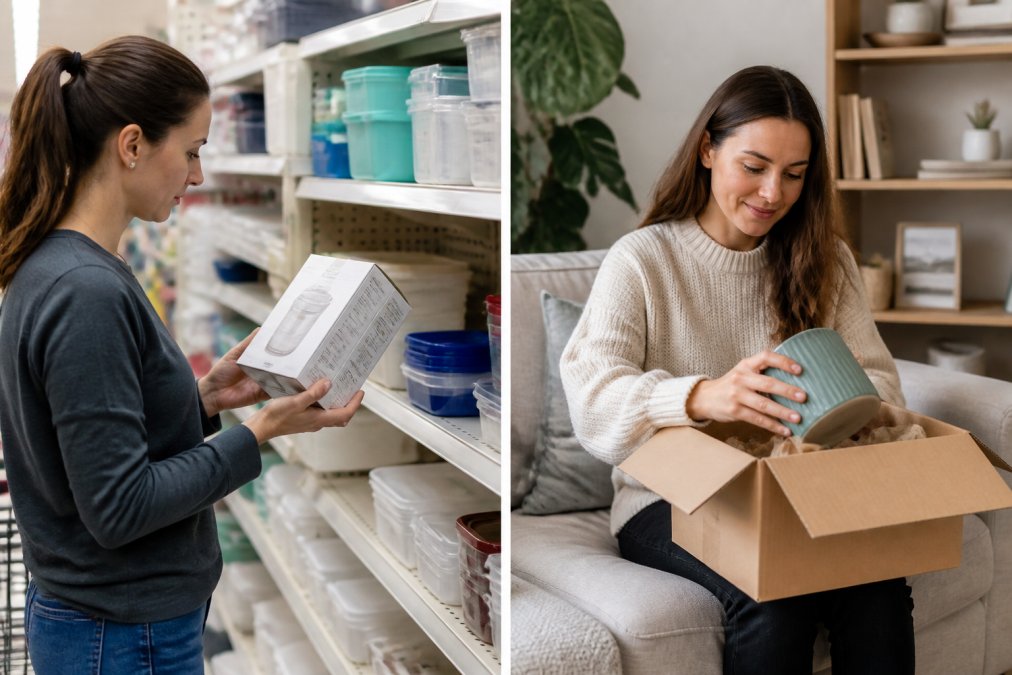
Shop online when:
- You know exactly what you want and need it delivered
- You're comparing prices across multiple retailers
- You value time savings over physical inspection
- You're buying from specialty retailers with limited physical locations
- Shipping is free or included in your membership
Shop in-store when:
- You're browsing for inspiration or unexpected finds
- You want to inspect quality, color, or fit before committing
- You need an item immediately
- You prefer the tactile experience of touching and seeing items
- You want to avoid shipping costs on heavy or large items
The hybrid approach works best: research online, compare prices, read reviews, then decide whether to buy online or visit a physical location. For furniture and home decor especially, seeing items in person often prevents costly returns.
Custom Sourcing: Finding Specialty Items Beyond Standard Inventory
Sometimes you need something specific that standard retailers don't stock. Tools, Handbags, and More offers custom sourcing services, helping customers locate specialty items, whether it's a specific drone model, limited-edition Stanley tumbler, or niche home good, even when items aren't in current inventory.
Custom sourcing works best for collectible or limited-edition items, specialty tools or equipment, hard-to-find home goods or decor, and items across multiple categories. The benefit is time savings and access to items you couldn't find through standard retail channels.
Houshold shopping no longer means defaulting to a single retailer. Each platform excels in specific categories and shopping experiences. Amazon dominates speed and selection. Walmart undercuts on price. IKEA delivers design-forward affordability. HomeGoods specializes in discovery. Understanding these distinctions lets you shop smarter, save money, and find exactly what you need.
When you need access to a wider range of options, Tools, Handbags, and More combines diverse product categories with personalized assistance through custom sourcing. Whether you need practical tools, stylish handbags, collectible items, or home essentials, the platform's strength lies in helping you find what you're actually looking for. Get started with Tools, Handbags, and More and discover how personalized sourcing transforms your shopping experience.
Frequently Asked Questions
What stores are similar to Target for home decor?
Several retailers offer comparable home decor selections. Amazon provides the widest variety with fast shipping; Walmart matches Target's price points and breadth; HomeGoods specializes in unique, discounted decor with frequent new arrivals; IKEA focuses on modern, functional furniture; and Overstock offers designer brands at lower prices. Each excels in different areas, choose based on whether you prioritize speed, style, budget, or discovery.
Is Walmart or Amazon better for household essentials?
Both excel in different ways. Amazon offers faster delivery (often same-day for Prime members), unmatched product variety, and customer reviews to guide purchases. Walmart provides lower prices on many essentials, convenient in-store pickup, and free shipping on orders over $35. For budget-conscious shoppers buying in bulk, Walmart typically wins; for convenience and speed, Amazon usually leads. Your choice depends on whether you prioritize cost or delivery time.
Where can I find affordable kitchenware besides Target?
Dollar General and Family Dollar offer the cheapest basic kitchen items, often starting at $1. Walmart provides mid-range kitchenware at competitive prices with good selection. Bed Bath & Beyond specializes in kitchen essentials with frequent sales and promotions. For specific, higher-quality pieces, consider custom sourcing services that hunt down exact items you need, even if they're not in standard inventory. Price-per-unit comparisons often reveal that discount stores offer better value on bulk household supplies.
What should I consider when choosing a household gear retailer?
Evaluate shipping costs and carbon footprint, local pickup or in-store shopping reduces environmental impact. Compare price-per-unit for items you buy regularly; bulk options at warehouse-style retailers often cost less long-term. Check return policies, especially for specialty items or custom orders. Consider whether you need a curated marketplace with personalized assistance or prefer browsing independently. Factor in delivery speed versus cost, and whether you value transparency about supply chain and ethical sourcing practices.
This article was written using GrandRanker