

Sustainable Lifestyle Product Alternatives for Beginners
Table of Contents
- How to Start a Sustainable Lifestyle Without Overhauling Everything
- Eco-Friendly Household Swaps That Cost Little or Nothing
- What Belongs in a Zero Waste Starter Kit for Beginners
- Reusable Water Bottles, Totes, and Other Everyday Carriers
- Natural Fiber Textiles and Durable Goods That Outlast Fast Alternatives
- How to Spot Greenwashing Before You Buy
- What Happens at the End of a Product's Life
- Frequently Asked Questions
Last Updated: September 28, 2026
How to Start a Sustainable Lifestyle Without Overhauling Everything
Starting a sustainable lifestyle does not require replacing everything you own in a single weekend. The most durable approach is the one-swap-a-week method: replace one disposable item with a reusable or compostable alternative each week, and let the habit compound.
Why Beginners Quit (and What Actually Sticks)
Three barriers show up repeatedly, each with a free workaround:
- Cost anxiety. Beginners assume going green means a $40 stainless bottle, a $30 beeswax wrap set, and a $60 compost bin in one order. Start with swaps using items you already own, cloth rags from cut-up t-shirts, glass jars from pasta sauce, a free conference tote.
- Decision fatigue. Dozens of "eco-friendly" labels, no single authority. Pick one room and one product category, and ignore everything else for 30 days.
- Perfectionism. Beginners quit after one slip, a forgotten tote, a takeout container. Treat the first month as data collection, not a test. A missed swap tells you what your routine needs.
The One-Swap-a-Week Method
Pick one room. Pick one product you throw away regularly. Replace it with a durable or refillable version, then live with that change for seven days before adding another.
- Week 1: Swap paper towels for cloth rags
- Week 2: Swap plastic water bottles for one reusable bottle
- Week 3: Swap plastic produce bags for cloth totes
- Week 4: Swap liquid soap bottles for a refillable dispenser
The Zero-Dollar Starter Path
Before buying anything, run this two-week audit, the highest-leverage habit in this guide, and it costs nothing:
- Week 1, Track your trash. Keep a small bin or bag for everything you personally throw away. Do not change your behavior. Just collect.
- Week 2, Sort and count. Group the contents into categories: food packaging, bathroom items, cleaning supplies, paper products, textiles. Count how many of each you discarded.
- Rank by volume. The category with the highest count is your first swap. Not the one that sounds most eco-friendly, the one you actually throw away most.
What to Ignore When You're Just Starting Out
Ignore anything requiring a specialty store, subscription, or large upfront spend. A common mistake is buying a "zero waste starter kit" full of items you will never use. Buy only what replaces something you already throw away.
The Cost-Per-Use Math That Makes This Affordable
Beginners assume reusable items cost more. Sometimes they do, but what matters is cost per use, not sticker price.
- A pack of paper towels might last a household two weeks. A set of cloth rags made from old t-shirts lasts years and costs nothing if you already own the shirts.
- A single reusable water bottle that lasts three years replaces hundreds of single-use bottles over that period.
- A refillable soap dispenser plus a large refill container usually costs less per ounce than repeatedly buying small bottled soap.
A Realistic First 90 Days
- Days 1-14: Run the trash audit. Buy nothing.
- Days 15-30: Make your first swap using something you already own.
- Days 31-60: Add one purchased swap, typically a reusable water bottle or a set of cloth produce bags.
- Days 61-90: Add one more swap and review what stuck. Drop anything that did not.
Three months in, most beginners have replaced four to six disposable items and spent very little, a pace that lasts.
Eco-Friendly Household Swaps That Cost Little or Nothing
The best eco-friendly household swaps are free or nearly free. You do not need to buy anything to start reducing single-use plastic in your kitchen and bathroom, most use items you already own or can repurpose.
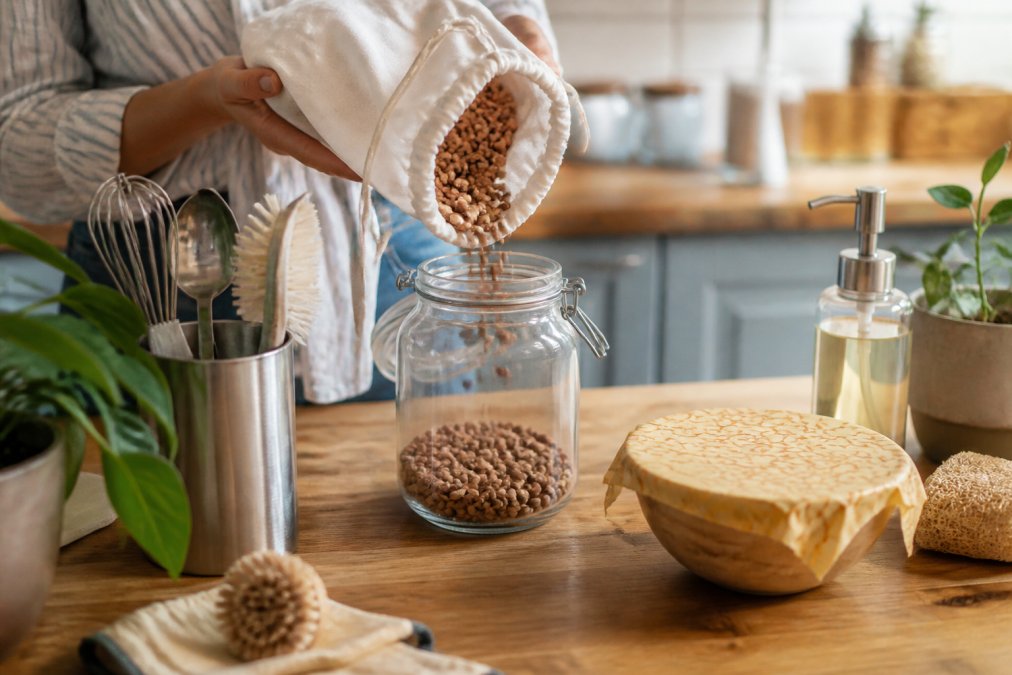
Kitchen and Cleaning Swaps
- Cut sponges into smaller pieces to extend their life
- Use vinegar and water instead of bottled surface cleaners
- Replace paper napkins with cloth napkins you already have
- Store leftovers in glass jars instead of plastic containers
- Bring your own bags to the grocery store
Bathroom and Laundry Swaps
- Install a low-flow showerhead to cut water use
- Switch to bar soap wrapped in paper instead of bottled body wash
- Use wool dryer balls in place of dryer sheets
- Hang clothes to dry when weather allows
None require a purchase. They cut household waste and save money, the part most sustainability guides skip.
What Belongs in a Zero Waste Starter Kit for Beginners
A zero waste starter kit should contain five to seven items, not thirty, a kit you actually use daily. Anything beyond that is clutter with a green label.
Here is a practical starter kit:
- One reusable water bottle
- Two to three cloth tote bags
- A set of cloth produce bags
- A refillable soap or cleaning dispenser
- A small compost bin for kitchen scraps
- Beeswax wraps for food storage
- A set of glass storage containers
Reusable Water Bottles, Totes, and Other Everyday Carriers
Reusable carriers are the highest-value beginner swap because they replace the most frequently discarded items. One reusable water bottle can replace hundreds of single-use bottles over its lifetime; a sturdy tote replaces years of grocery bags.
Natural Fiber Textiles and Durable Goods That Outlast Fast Alternatives
Natural fibers like cotton, linen, wool, and hemp outlast synthetic fast-fashion alternatives and biodegrade at end of life, which is why they anchor most sustainable wardrobes and home goods.
- Look for: reinforced stitching, thicker fabric weight, repairable construction
- Avoid: blends that mix natural and synthetic fibers, since these are hard to recycle
- Prioritize: items you will wear or use weekly, not occasionally
How to Spot Greenwashing Before You Buy
Greenwashing is marketing that makes a product sound environmentally responsible without backing the claim with verifiable standards. The Federal Trade Commission's Green Guides set the rules for how environmental claims can be made in advertising, and they are worth knowing before you trust a label.
Red flags to watch for:
- Vague terms like "eco-friendly" or "green" with no certification
- Imagery of leaves and earth tones on a product with no verifiable claim
- Claims about one small feature while ignoring the bigger environmental cost
- No ingredient list or materials disclosure
What Happens at the End of a Product's Life
Disposal is the part most beginner guides skip. A product is only as sustainable as its end-of-life path. Before buying any "green" alternative, ask where it goes when you are done, and what happens to the plastic item you are replacing.
The Hierarchy: Reuse Beats Compost Beats Recycle
For most beginners, the honest ranking is:
- Reuse, keeps an item in circulation longest and requires the least infrastructure.
- Compost, works only if you have a home or municipal system that actually accepts the material.
- Recycle, depends entirely on whether your local program accepts that specific material.
A compostable item in a landfill can sit for years without the oxygen it needs to break down, and biodegradable plastics often need industrial composting most households cannot provide. "Compostable" is a claim about a facility, not your backyard.
What to Do With the Plastic You're Replacing
The most common beginner question is not "what do I buy?" but "what do I do with all this plastic I already own?" Throwing it out feels like defeat; hoarding it feels worse. Here is a practical order of operations:
- Use it up first. A plastic bottle you already own has already been manufactured. Finishing it and then switching creates less waste than discarding it early to buy a reusable version.
- Rehome what still works. Unopened or gently used items can go to Buy Nothing groups, local mutual aid networks, or shelters that accept household goods.
- Recycle what your program accepts. Check your municipality's accepted-materials list before tossing anything in the bin. Wishful recycling, putting items in hoping they get recycled, contaminates the stream and can send whole loads to landfill.
- Landfill the rest without guilt. Some plastic has no recycling path in most programs. Discarding it responsibly is not a failure; it is the honest end of a product that was never designed to be recycled.
How to Check What Your Local Program Actually Accepts
Recycling rules vary block by block, and the chasing-arrows symbol is not a guarantee. The number inside the triangle (resin identification code 1 through 7) tells you what the plastic is made of, not whether your program takes it.
- Look up your municipality's or hauler's accepted-materials list before assuming an item is recyclable.
- Check whether your area uses single-stream or sorted recycling. Single-stream is more convenient but has higher contamination rates.
- Note that many programs accept only #1 and #2 plastics, typically bottles and jugs, and reject clamshells, bags, and films even when they carry a recycling symbol.
- Plastic bags and films almost never belong in curbside bins. Most grocery stores and big-box retailers maintain drop-off bins for these instead.
Composting: What Actually Breaks Down
For compostable items to live up to their label, you need a system. Two options exist for beginners:
- Backyard composting handles fruit and vegetable scraps, coffee grounds, eggshells, and yard waste. It generally does not reach the temperatures needed to break down certified compostable plastics or bioplastics.
- Municipal or commercial composting is required for most "compostable" packaging and utensils. Check whether your city offers curbside organics collection or a drop-off site.
The Question to Ask Before Every Purchase
"Where does this go when I'm done with it, and do I actually have access to that path?" If the answer is "the landfill," the item is not automatically bad, but it is not the sustainable upgrade it claims to be. Reuse is the only end-of-life path that does not depend on infrastructure you may not have.
Frequently Asked Questions
What are the easiest sustainable swaps for beginners?
Start with items you replace often: a reusable water bottle, cloth shopping bags, refillable soap dispensers, and beeswax wraps instead of plastic wrap. Swap one item at a time so the change sticks. A zero waste starter kit with a few of these basics gives you a simple, low-cost starting point, and you can add more eco-friendly household swaps as each item wears out.
How can I start a sustainable lifestyle on a budget?
Use what you already own before buying anything new. Repair or repurpose items, buy secondhand, and choose durable goods that last longer. Focus on free or low-cost eco-friendly household swaps like line-drying laundry, using rags instead of paper towels, and buying bulk. A sustainable lifestyle is about waste reduction and resource conservation, not spending more.
How do I tell truly sustainable products from greenwashing?
Look for specific, verifiable claims rather than vague words like 'natural' or 'green'. Check eco-labels, ingredient lists, and whether the brand explains disposal or end-of-life instructions. If a product claims to be biodegradable or compostable, the label should say what conditions it needs. When a claim has no specifics, treat it as marketing until proven otherwise.
Are sustainable products actually more effective than conventional ones?
Often they perform just as well. Reusable water bottles, natural fiber textiles, and refillable cleaners are designed for repeated use and can outlast single-use plastic versions. The main trade-off is usually upfront cost, not performance. Try one swap at a time and judge by how it works in your home, not by the label.